Diatonic Harmony
A first step in understanding harmony is to gain knowledge of all the chords, triads, and arpeggios that are built from the major scale. All this information resides within the major scale and the goal is to be able to see it, hear it, understand it, and use it at will. Any groove or melodic phrase you play should outline the chords pertaining to the key of the moment.
Let’s break this information down to its most basic components. The C major scale contains the notes C D E F G A B C. If we were to assign numbers to each scale degree, it would look like this.
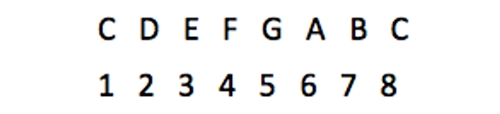
The key to learning all the traids, seventh chords, and arpeggios (the individual notes of the chords played separately) is to start from the root note C and skip a note each time in succession.

Use this same system starting from the second note D. This produces D minor.

Continue to the third note E which produces E minor.

Continue to the fourth note F which produces F major.

Continue to the fifth note G which produces G major and a G dominant 7th.

Continue to the sixth note A which produces A minor.

Finish at the seventh note B which produces a B diminished triad and a B minor 7th flat 5.

Now we’re going to pull all the triads out of the “C major scale.”
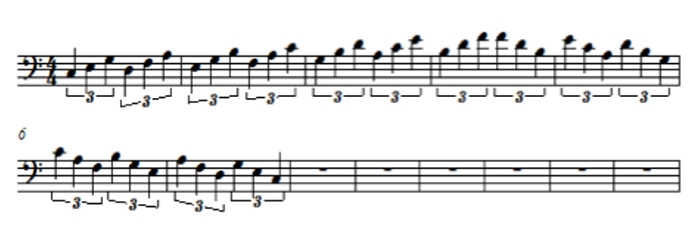
The next step is to pull all the seventh chord arpeggios of out the “C major scale.”
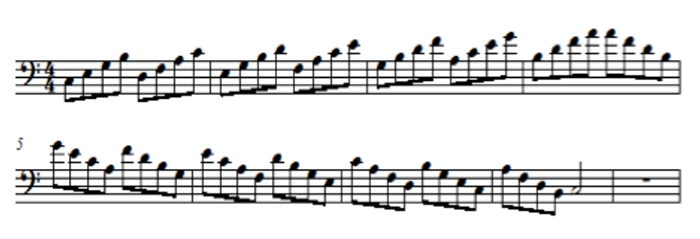
This is only a small step in the journey of learning harmony on your instrument. All the chords that were discussed should be studied and practiced on the piano. All these exercises should be taken through the modes and learned in all keys. In the next lesson, I’ll discuss some other variations and exercises to experiment with diatonic seventh chord arpeggios. Good Luck!

James Rosocha
Bassist James Rosocha is an educator, composer, and touring musician.
He can be heard on the last nine albums by jazz fusion guitarist B.D. Lenz or on his debut CD “Avalon.”
-
Four Beginner Guitar Tips That Make Everything Easier
Just Rijna
-
Will Weight Training Help My Guitar Playing?
Ioannis Anastassakis
-
Applying Negative Harmony To Modes
Tommaso Zillio
-
Avoiding Parallel 5ths In A Chord Progression
Tommaso Zillio
-
How To Be A 'Spider-Teacher’: Spinning With Your Students
Thijs de Klijn
-
Why You Should 'Gamify' Your Guitar Practice
Thijs de Klijn