The Double Chromatic Approach
In my previous article entitled “Guide Tones” we learned how to create lines using guide tones that resolve from one chord to the next. The third degree of the chord is important because it defines whether the chord is major or minor. The seventh degree also defines a major, minor, or flat 7th for dominant 7th chords. Please review my previous article before moving on. Your goal is to be able to create melodic lines that use guide tones that resolve from one chord to the next in a smooth, flowing fashion.
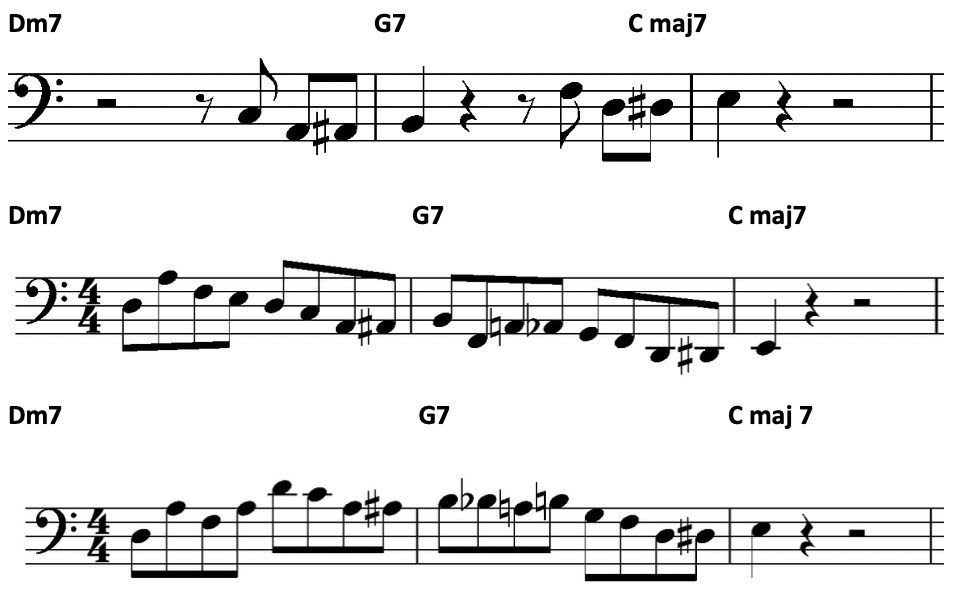
The next idea I’m presenting to you employs the double chromatic approach. Instead of resolving your melodic ideas from the 7th to the 3rd scale degree in ½ step intervals, the double chromatic approach resolves to the 3rd of the chords in a chromatic fashion.
The example below illustrates this concept. The third of the chord is being approached below by two notes in a chromatic sequence.
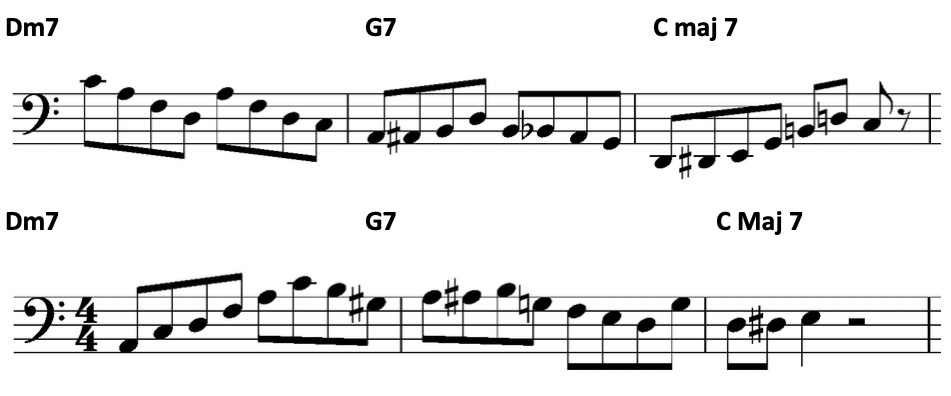
You can also employ the concept of “delayed resolution” using the chromatic approach. Instead of always resolving the guides tones on beat one of the progressions, try resolving your ideas on beat two using the chromatic approach. This creates a delayed resolution in your lines and adds a new twist to things.
Use the concepts I presented to you from both articles to write your own phrases. These musical ideas should be memorized, played in all keys, and become a part of you and your musical vocabulary. If you create one hundred of them, you’re well on your way to mastering these concepts. Good luck.

James Rosocha
Bassist James Rosocha is an educator, composer, and touring musician.
He can be heard on the last nine albums by jazz fusion guitarist B.D. Lenz or on his debut CD “Avalon.”
-
Four Beginner Guitar Tips That Make Everything Easier
Just Rijna
-
Will Weight Training Help My Guitar Playing?
Ioannis Anastassakis
-
Applying Negative Harmony To Modes
Tommaso Zillio
-
Avoiding Parallel 5ths In A Chord Progression
Tommaso Zillio
-
How To Be A 'Spider-Teacher’: Spinning With Your Students
Thijs de Klijn
-
Why You Should 'Gamify' Your Guitar Practice
Thijs de Klijn