Count-Ins And Click Tracks For A Whole Set List
The click began in film. In the 1930s Hollywood scoring stages punched it into the soundtrack of the picture and played it to the conductor, so that an orchestra hit its cues to the frame. Rock bands met it on stage forty years later. When The Who toured Who's Next after August 1971, Keith Moon wore headphones for "Baba O'Riley" and "Won't Get Fooled Again", because the synthesizer part came off tape and the tape did not follow the drummer.
Bands that play to backing tracks today carry the same arrangement in one stereo file. One or two bars of count sit in front of the song and end on beat one. The count and the click are on the left channel, the song is summed to mono on the right, and a Y cable or two mixer inputs send the left side to the in-ears and the right side to the PA. Any phone or laptop plays it, and no playback app has to run on stage.
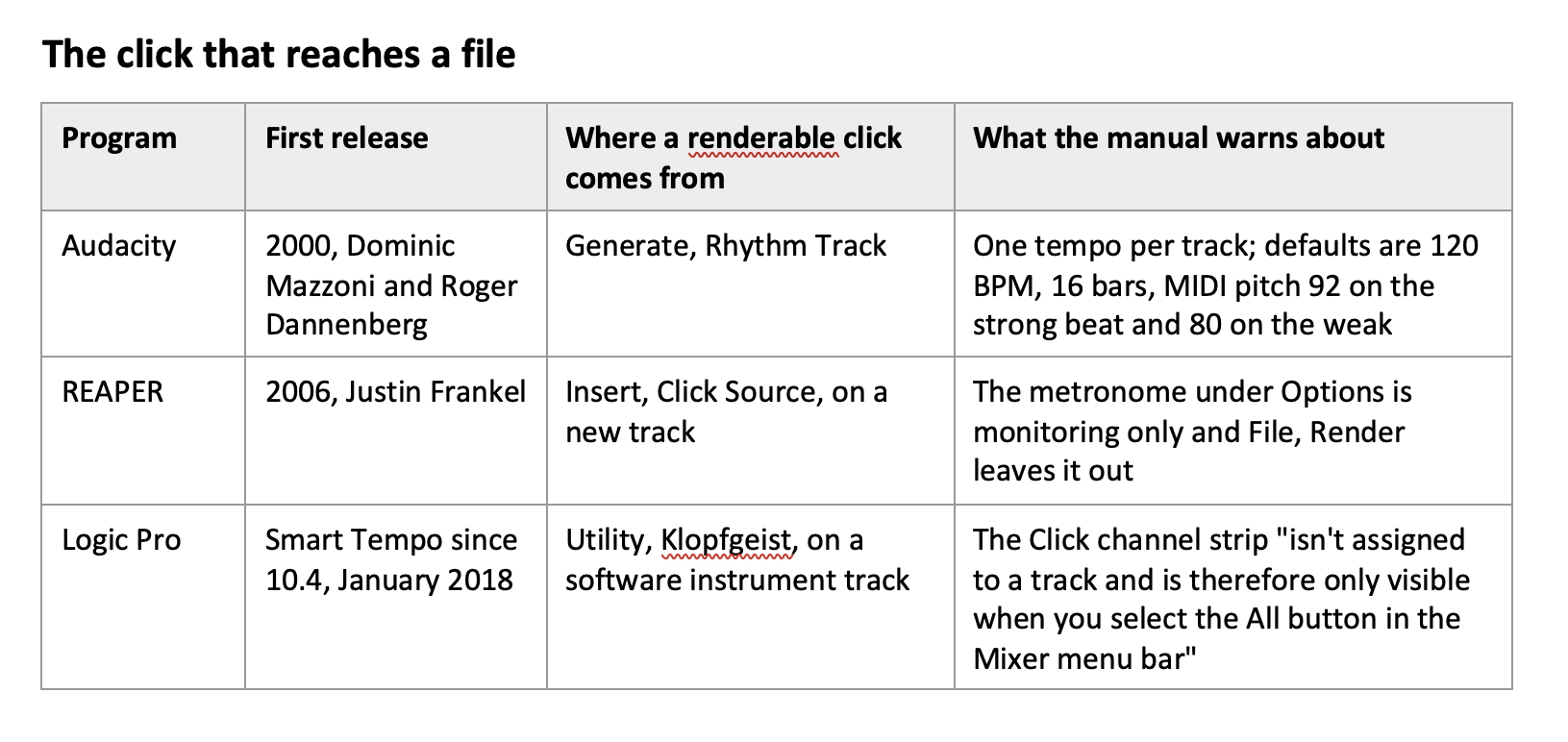
Klopfgeist is German for knocking ghost. Logic's guide describes its Tone slider as running from a short click to a pitched sound "similar to a wood block or claves", and it is the same instrument the metronome uses, which is why a click drawn as MIDI notes on a Klopfgeist track sounds identical to the one heard while recording. In REAPER the Click Source is a media item with a length, a fader and a pan; in Audacity the Rhythm Track is ordinary audio from the moment it is generated.
The count-in has no menu of its own in any of the three. At 120 BPM in 4/4 one bar lasts two seconds, so a two-bar count puts the first beat of the song at 4.000 seconds, and the song's clip is moved by hand until that beat sits on a click.
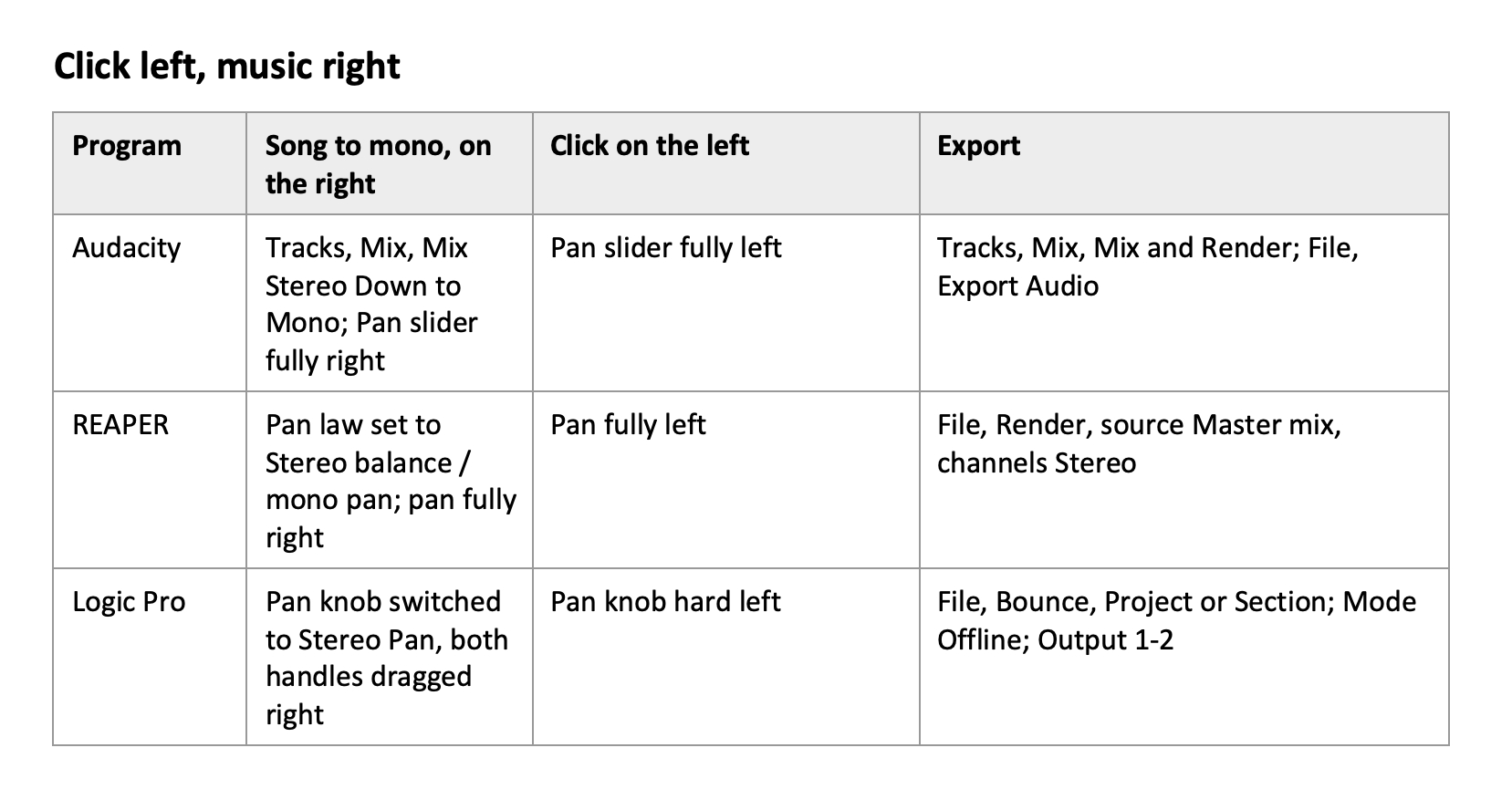
Logic's default Balance mode only turns the left channel down, so whatever was mixed to the left of the song is lost instead of being moved to the right. Its guide describes Stereo Pan as placing "the position of the left and right signals individually in the stereo field, as if you had two separate pan knobs".
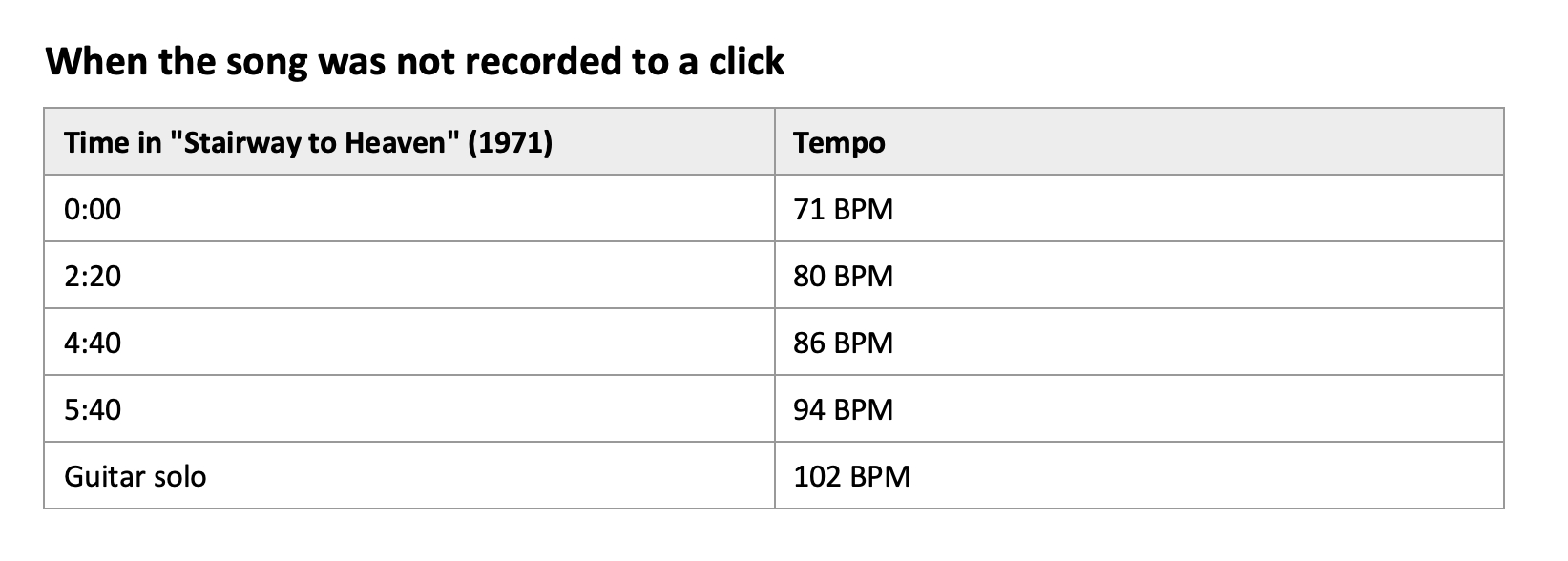
That is 43 per cent faster at the solo than at the first bar. "Honky Tonk Women" (1969) climbs from 113 to 126. "Hotel California" (1976) holds 74 for six and a half minutes, within a tenth of a beat, and is the only one of the three that a Rhythm Track at one tempo would fit.
For the others an editor needs a tempo map. REAPER's User Guide, version 7.81, gives the manual route for a live performance that was not done to a click: select one bar on the timeline, choose Create measure from time selection (detect tempo), or press Alt+Shift+C, and repeat to the end, which for a four-minute song at 100 BPM is a hundred selections. Logic's Smart Tempo, in Adapt Project Tempo mode, "places beat markers based on the musical tempo detection of an audio file", and its errors are corrected in the Smart Tempo Editor with downbeat hints and beat hints, one bar at a time. Ableton Live uses warp markers and Pro Tools uses Beat Detective. Audacity has no tempo map; its Beat Finder, threshold 65 per cent by default, writes labels, and the manual calls it "rough and ready".
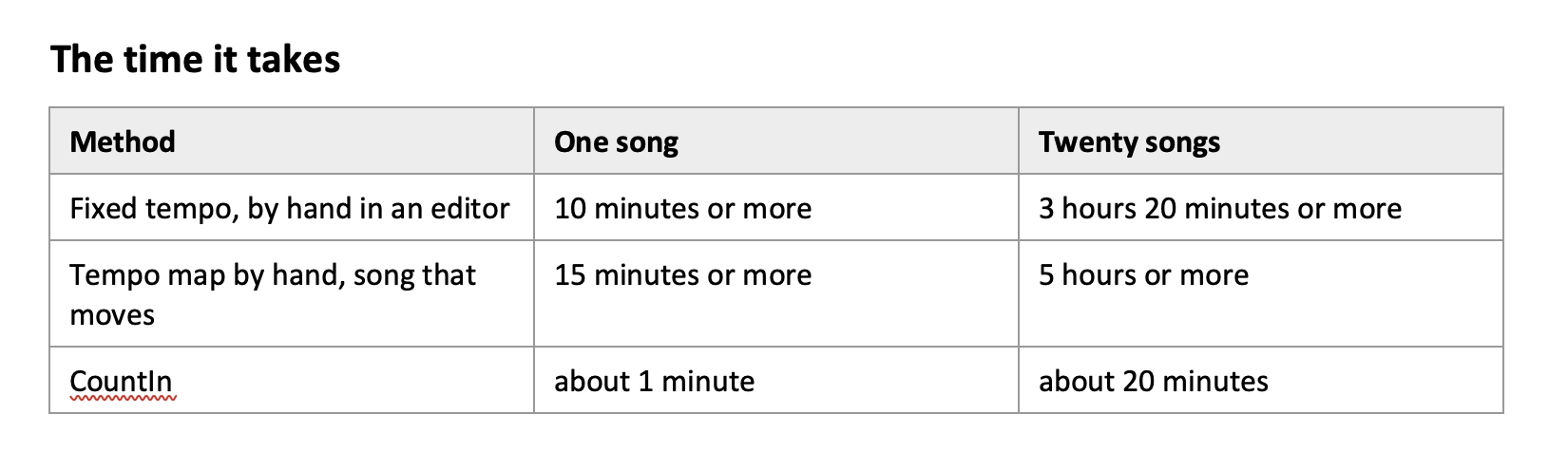
The ten minutes in the first row are the author's own figure from preparing tracks in an editor. The last row is CountIn, a browser tool written by the author of this column. It takes an MP3, WAV, M4A, FLAC or OGG file, finds the tempo and beat one, marks every beat of the recording and shows beat one as an orange marker on the waveform, which can be dragged. The count-in ends on that marker. With CLICK on, a woodblock or stick sound is placed on every measured beat, with beat one tuned higher, and the export is the split file from the second table. Listening on your own song is free and needs no account; exporting is paid. The steps are here
Where It Does Not Work
On a public set of 698 annotated recordings the beat detection found the right tempo family every time and placed beats within 10 milliseconds of the human annotation. Three kinds of music still defeat it. A rubato intro or a free-time breakdown has no pulse to follow, so the click guesses through it, metal above 200 BPM and heavy shuffles can wobble by a few milliseconds, and a bar that the band shortened by a beat drags the accent on beat one along with it. Jeremy Cottrell, a staff engineer at Blackbird Studio in Nashville, gave that last case in June 2025 as the reason some drummers ask for a click with no accent at all.
Sources
Audacity Manual: Rhythm Track; Beat Finder.
REAPER User Guide, version 7.81: metronome settings; Insert Click Source; Create measure from time selection.
Logic Pro for Mac User Guide, version 12.3: Metronome; Klopfgeist; Stereo Pan; Smart Tempo.
Inside Blackbird, YouTube, June 2025: Jeremy Cottrell on click tracks.
Tempos measured from the released recordings for the Song Tempo Check video series.
Paweł Kowalski
Paweł Kowalski has played electric guitar for 40 years. In the 1990s he founded the hard rock band Tequila in Lublin, Poland, where he was the guitarist and composer.
Today, as Smith Riff, he makes Famous Count-Ins, a YouTube series about the stories behind the best-known count-ins on record.
He also builds CountIn, a browser tool that adds a count-in or a click track to backing tracks.
-
From a Simple Melody to a Finished Solo Guitar Piece
Udi Glaser
-
Four Beginner Guitar Tips That Make Everything Easier
Just Rijna
-
Will Weight Training Help My Guitar Playing?
Ioannis Anastassakis
-
Applying Negative Harmony To Modes
Tommaso Zillio
-
How To Be A 'Spider-Teacher’: Spinning With Your Students
Thijs de Klijn
-
Avoiding Parallel 5ths In A Chord Progression
Tommaso Zillio