The Guitar Player's Resource
Hello everyone and welcome to the third installment of our look at arpeggios. Up until now we have been looking at fairly simple arpeggios that are based off of triads. Although they sound very cool when played at blinding speed across the fretboard, they are not the most harmonically sophisticated arpeggios around. This time we will check out some much more rich sounding shapes, starting with seventh chord arpeggios.
The basic seventh chords we will look at here are major and minor seventh, as well as, dominant, half-diminished, and diminished shapes. A quick review of our chord theory will show you that the intervals that comprise these arpeggios are as follows: Major Seventh (1-3-5-7), Minor Seventh (1-b3-5-b7), Dominant Seventh (1-3-5-b7), Half-Diminished (1-b3-b5-b7), and Diminished Seventh (1-b3-b5-bb7). Understanding this will make it easier not only to distinguish the arpeggios from each other, but will be critical in knowing how to apply them.
Unlike the triad arpeggios we have looked at before where you had only one note per string, these shapes will all have multiple notes on many of the strings throughout. Although each of these shapes differ, the approach to sweeping does not. As always, use a falling motion on the way up and a dragging motion on the descend. It is really important to use a metronome when developing speed here because of the multiple hammer-ons and pull-offs necessary to make these guys burn. Take it slow at first and set the metronome to a moderate tempo playing them in eighth notes.
Initially you will want to increase the speed by increasing the division to the beat from eighth notes to triplets, to sixteenth notes, and eventually to sixteenth note triplets. Once you have arrived at sixteenth note triplets comfortably, set a goal tempo formula to get faster. Yes, it may take you a while before you are rippin', but remember playing fast means nothing unless it is clean and in control.
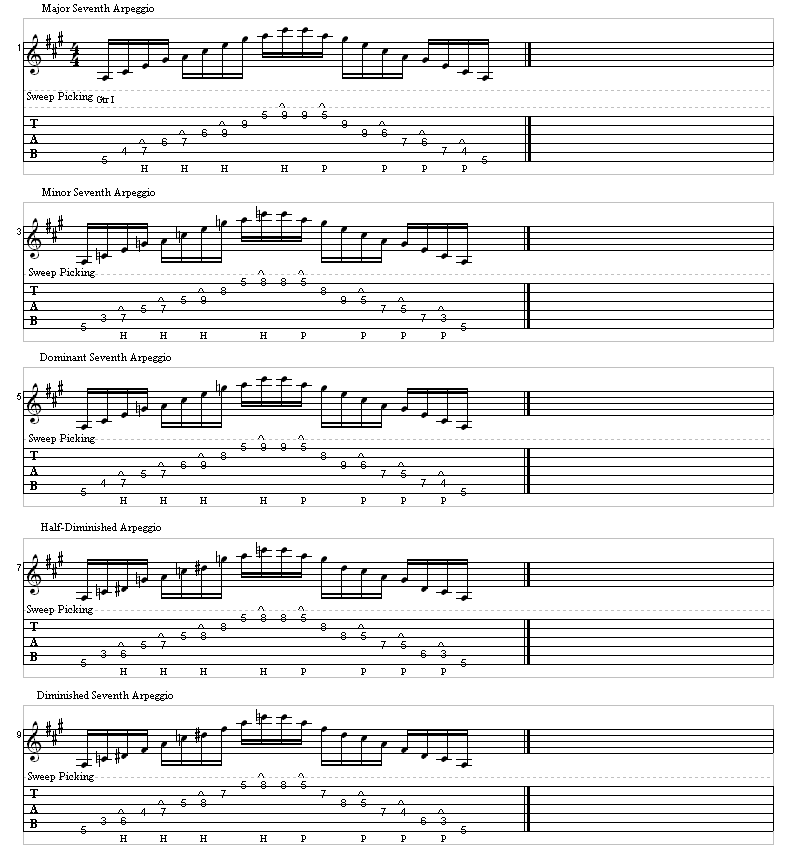 Click To Enlarge Click To Enlarge |
Once you have the patterns under your fingers you will want to learn them diatonically in every key. Remember these formulas:
Major Key - 1st scale step Major Seventh, 2nd scale step Minor Seventh, 3rd scale step Minor Seventh, 4th scale step Major Seventh, 5th scale step Dominant Seventh, 6th scale step Minor seventh, 7th scale step Half-Diminished/Diminished Seventh.
Minor Key - 1st scale step Minor Seventh, 2nd scale step Half-Diminished/Diminished, 3rd scale step Major seventh, 4th scale step Minor seventh, 5th scale step Minor Seventh, 6th scale step Major Seventh, 7th scale step Dominant Seventh.
The basic seventh chord shapes are excellent building blocks to even more interesting arpeggios. You can make them ninth chord arpeggios by simply adding a ninth. You can make thirteenth and eleventh or sharp eleventh arpeggios by adding (you guessed it) thirteenths, elevenths and sharp elevenths.
If you add a raised or flatted ninth or fifth to a dominant arpeggio you have created what is called in the business an altered pentatonic scale. If you add a sharp eleven to a major or minor seventh arpeggio you make it a major or minor Lydian pentatonic scale. No, these are not the B.B. King pentatonic scales we all know and love, these are pentatonic scales because the definition of a pentatonic scale is a five-note scale. These are seriously fresh sounding scales that you owe it to yourself to check out.
Last thing I want to mention on these kinds of arpeggios is the wonderful diminished seventh arpeggio. Because of the symmetrical nature of this arpeggio (built entirely out of minor thirds), this shape has some nice advantages.
The first advantage is that if you take any diminished arpeggio and play it up the neck by moving it up constantly in minor thirds, you simply have one long diminished arpeggio in many different inversions. Yngwie figured this one out a long time ago but it works brilliantly in a myriad of situations. You can play it over diminished chords of course, but it also works great over Locrian metal progressions. It can also work over Phrygian dominant, as well as, altered dominant chords.
The second way to stretch out (literally) a Diminished Arpeggio is to not sweep it, but to put three minor thirds together on one string and play by moving the pattern up a half step on each string. Skip the B string and go directly to the high E on the same fret as you played the G string. You will notice that minor third pattern here again. If you want to see a great example, you should check out some of the late great Shawn Lane's instructional videos. These are an absolute treasure trove of new and exciting diminished ideas. That's it for now, be back next time to finish up this series on arpeggios with string skipping and tapped arpeggios.
Scott Allen is a 1996 graduate of the Musician's Institute, G.I.T. He currently teaches guitar to 65 to 70 students weekly at Northridge Music Center.
His latest CD is entitled "III", featuring his impressively fluid playing, with a style marked by an incendiary sense of phrasing.