Moveable Forms
The beautiful part about the tempered music scale we all use lies in it's flexibility. One of my favorite tricks is to take one shape, and use it to move up or down the fretboard in a linear way. The similarities in chord shapes allow me to do this. To give you an example, I'll use one shape of a minor 7 chord. In any given key, there are 3 natural minor seven chords, and their structures are the same. Therefore, if you find one shape of a minor 7 chord, you've got 3 you can use. For example, in the key of A, the minor chords are B, C# and F#. Here is one shape that each of these chords share:
B Minor 7
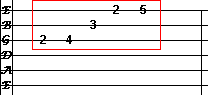
Example A - MP3
C# Minor 7
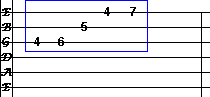
Example B - MP3
F# Minor 7
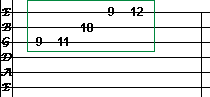
Example C - MP3
Now, let's use these in an example:
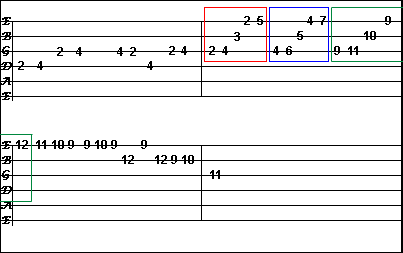
Example D: slow - MP3
Example D: quick - MP3
Notice how we started off in the 2nd position, and by the time we're done, we're in the 9th position. This is just one way to travel smoothly across the neck. While this example uses a linear movement, you can also use like shapes to ascend and descend from low strings to high and vice versa. Now, go find some more common chord forms and move some air!

Ken Burtch
Ken Burtch, a guitarist and composer from Washington, has recently taken the big step from entering guitar competitions to releasing his own record. Fulfilling a lifelong dream, his eponymous debut CD features five instrumental tracks that combine soaring melodies with a blend of contemporary techniques.
Ken is also featured on the Generation Ibanez Project compilation CD, "Across The Miles", along with Eric Sands, Rusty Cooley and other devotees of the Ibanez seven-string family of instruments.
-
Four Beginner Guitar Tips That Make Everything Easier
Just Rijna
-
Will Weight Training Help My Guitar Playing?
Ioannis Anastassakis
-
Applying Negative Harmony To Modes
Tommaso Zillio
-
How To Be A 'Spider-Teacher’: Spinning With Your Students
Thijs de Klijn
-
Avoiding Parallel 5ths In A Chord Progression
Tommaso Zillio
-
Why You Should 'Gamify' Your Guitar Practice
Thijs de Klijn