Triad Arpeggios
Welcome back! In this lesson I will be showing you some ways you can practice triad arpeggios and to gain fluency with them. I have covered triads in previous lessons, as chords and arpeggios. I can’t stress the importance of knowing them inside and out. They are the basis for all harmony and melody and there are different types, such as major, minor, diminished, augmented, sus4, Lydian, etc. Knowing triads all over the neck will help your soloing, rhythm playing, composition and melodies.
For this lesson we will stay in the major scale and use the triads within the key of F major. Also, I won’t go in depth into the theory behind triads and how to construct them. Be sure to apply this concept to every scale and key. We will be playing all of the examples arpeggiated, and I use alternate picking for the whole lesson.
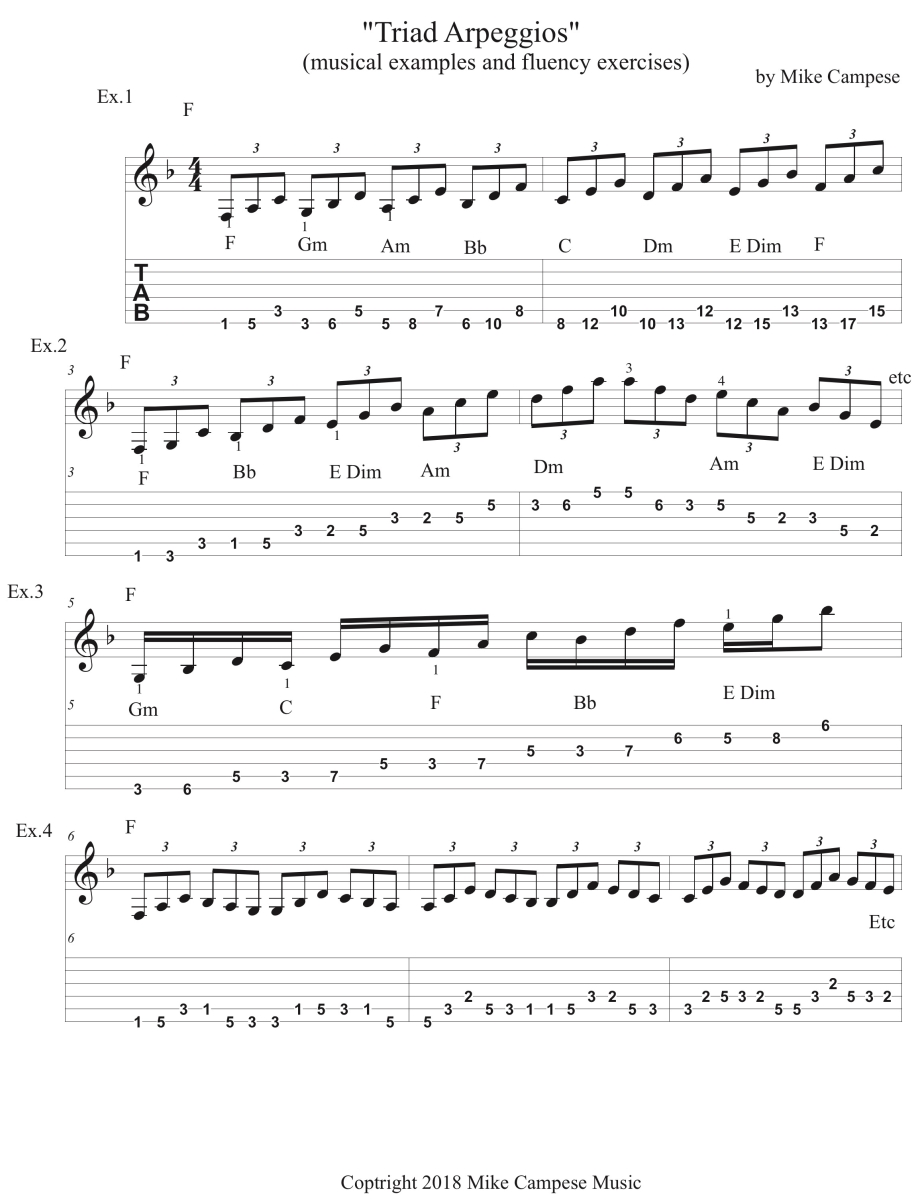
Example 1 is a chord scale in the key of F Major, played as arpeggios. The chord scale formula you should know for a major scale is: major, minor, minor, major, major, minor, diminished. In F major the chords are: F, Gm, Am, Bb, C, Dm, E Dim. Be sure to play these arpeggios in all positions and on all of the strings on the guitar.
MP3 - Triad Arpeggios - Example 1
For Example 2, we are staying in one position on the neck, in this case, the example is in the F ionian scale position and we are playing the available arpeggios off of each string. For example F, Bb, E Dim, Am, Dm, etc. Reverse the pattern, descending down the neck and apply this same concept to all the scale positions and modes.
MP3 - Triad Arpeggios - Example 2
Example 3 uses the same concept from the previous example, staying in one position and playing the triad arpeggios off of each string. In this case, we are in the G Dorian position if you remain within the notes of the F major scale. Also, this example is constructed using 16th notes instead of triplets, and that will give it a different feel.
MP3 - Triad Arpeggios - Example 3
Now we will add notes to the arpeggios for Example 4 from the key of F major and play this as a sequential pattern using triplets. This makes the arpeggios more musical instead of running them straight up and down. We are staying in one position, but this can be played anywhere on the neck. Be sure to alternate pick these examples.
MP3 - Triad Arpeggios - Example 4
OK, that is it for now! Be sure to make up your own ideas and experiment. Please visit www.mikecampese.com for the latest news, updates and album information.

Mike Campese
Mike Campese is an all-around music performer, session artist and teacher competent in many musical styles, electric and acoustic. He has studied at G.I.T. (Honors Graduate), and with Paul Gilbert, Norman Brown, Stanley Jordan, Scott Henderson and Keith Wyatt.
-
Four Beginner Guitar Tips That Make Everything Easier
Just Rijna
-
Will Weight Training Help My Guitar Playing?
Ioannis Anastassakis
-
Applying Negative Harmony To Modes
Tommaso Zillio
-
Avoiding Parallel 5ths In A Chord Progression
Tommaso Zillio
-
How To Be A 'Spider-Teacher’: Spinning With Your Students
Thijs de Klijn
-
Why You Should 'Gamify' Your Guitar Practice
Thijs de Klijn