
The Guitar Player's Resource
There are as many ways to ascend up your guitar neck as there are hairs on a camel's back. Before you go counting Joe Camel's folicles, let me explain myself. Many times when guitarists need a flashy ending or a cool intro to a solo, a good ascending scale run up the neck gets the ball rolling. Unfortunately, creatvity tends to go out the window as the guitarist tears into a stock run that we've all heard dozens of times.
A very common ascending run goes something like this:

This A minor triplet run does get you up the neck but it's not terribly exciting or original is it? Following are three different ascending run ideas you can try. All of them can be used in the key of E minor or G major.
The first run advances the idea of using lower notes as variations on the basic ascending run. In addition, the pattern is varied slightly towards the middle to add interest. It's not really necessary to always play a stock pattern the same way for each position on the neck. Sometimes you can play notes accidentally out of sequence and it winds up sounding better.
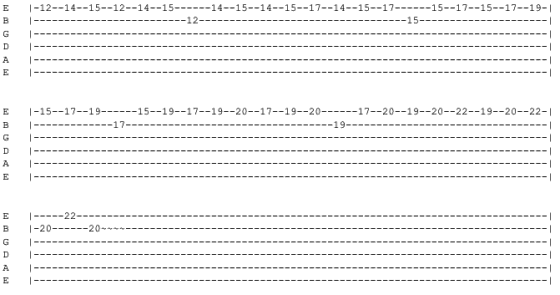
Example 1: slow - MP3
Every time you ascend with Exercise 1, try a slightly different set of notes on the B string and you can come up with a lot of cool runs.
The second example of an ascending run uses the third note of the ascending triplet as a mini-pedal tone. Notice the first triplet B-C-D: The D note is uses as a pedal for two notes on the B string. It adds a bit of a descending feel to the pattern, yet you are still moving up the neck.
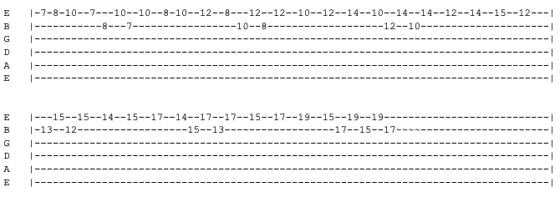
Example 2: slow - MP3
For my third and last example I wanted to show how you can use a descending idea along with pentatonic notes instead of the typical minor scale, yet keep it movin' up the neck. Most ascending ideas use minor, major, or diminished scales, but using pentatonics gives an Oriental feel to the lick. In fact, a great way to make your own variations on typical ascending patterns is to begin by removing notes. Additionally, you can make up your own pentatonic scales simply by choosing any five notes from the major scale. You don't have to limit yourself to the pentatonic scale your guitar teacher showed you.
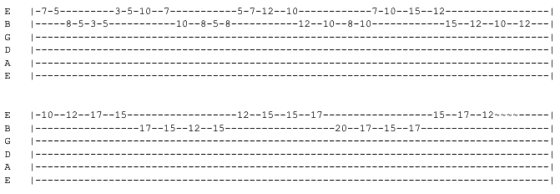
Example 3: slow - MP3
Have fun with these examples and remember that you can come up with almost an unlimited number of variations on the basic ascending theme. With that in mind you may find you never have to descend again.
Dan McAvinchey is a guitarist and composer living in Raleigh, NC.
He believes every musician or composer has the power to write, record and release their own music.