
The Guitar Player's Resource
Tim Jenkins: A lot of the things that influenced my taste in music were really not
related to music. I have sort of always been drawn to sounds, paintings and writing that had a kind of searching quality to it. The guys I listened to early on were probably Michael Hedges, Allan Holdsworth and Phil Keaggy. Since then I really like the playing/writing of guys like Pat Metheny, Ralph Towner, ill
Evans, Joni Mitchell, John Abercrombie, Wes Montgomery, Jaco Pastorius, Sonny Rollins, Miles Davis' second great quintet, Bil Frisell, Kurt Rosenwinkel, Dave Holland, Bill Bruford,Johnny Smith, Tal Farlow, Grant Green, Ben Monder, Ed Bickert, Pat Martino, etc.
Tim Jenkins: I have an Epiphone jazz box that I love and tend to use for straight ahead stuff. I also have a 70's Strat, and a semi-hollow Samick that sounds
great, plus a couple of acoustics made by Seagull. My main amp is a Peavey
classic 30 for live stuff, but in the studio I use a Crate tube amp with 3 ten-inch speakers. I'm not much of an effects guy. I have a few Boss pedals and a
Line 6 delay modeler I use for looping. Also, on our last record I used a Roland
synth for some textures.
Tim Jenkins: To improvise a little closer to what I'm hearing and to continue to compose exactly what's in my head (ECM wouldn't be bad either).
Tim Jenkins: The most recent Delirious Tremor CD, "Swelling Not To Burst", came out in April, 2002. We will be recording our third CD in November and are playing around
Baltimore and Washington DC. I hope to also record an acoustic album soon, and I am also working with a group of musicians who write and perform unusual sounding (to Western
harmony) acoustic music which uses a lot of drones and altered scales.
Tim Jenkins: I usually stumble on 2 or 3 chords that seem to want to go
somewhere. Ocassionally, a song will present itself melody first. Some music
comes quickly over a period of days or hours, some tunes take months. I try not
to force myself to write. I prefer to let the song come to me which it
usually does when it's good and ready. Ultimately, I put together a chart and we
hack it out in the basement.
Tim Jenkins: I recently purchased an 18 track digital recorder made by Roland. I love having it and I'm amazed at the quality recordings with relatively little effort. I plan to do the third Delirious Tremor CD with it, as well as most future
projects. To answer your question - everything up to now has been done in
commercial studios. Both Delirious Tremor CD's have been done with Bill Pratt in Baltimore.
Tim Jenkins: I did shop a demo of our first CD and found it difficult to actually speak to someone who had listened or even knew what I was talking about. It finally
ocurred to me that the stuff I had written was different and pretty close to unique, and I reminded myself that I was very happy to have music available anywhere. Really, to me it is an accomplishment to just put it out - so I went ahead and did it.
Tim Jenkins: I have no concept of what it would be like to have a deal of some sort. I can only assume that it comes with its own unique headaches and worries. I try
to focus on things I can control, and I feel very fortunate to be able to make a
living playing, writing and teaching music. It can be frustrating at times
because if you write music that you truly hear and feel, there is a good
chance that no one outside of your friends, faamily and a few others will ever
hear it. The music really is why I put out records - the documentation of
compositions inspires me to write more, regardless of sales or reviews. As an
independant artist, I suppose I never have to worry about that stuff.
Tim Jenkins: I think the most important thing is to play wherever you can. I have had pretty good luck selling CDs playing for free at benefits. People are generally in a giving mood and appreciative of live music (in my case, solo guitar).
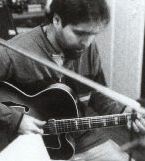
Guitarist Tim Jenkins leads the fusion group known as Delirious Tremor, a project in which he teams with drummer Dave Huether and a team of bass players. Their music is a blend of progressive jazz, world and electric fusion, and Jenkins can supply intense, angular, overdriven guitar lines when the situation demands it.
Dan McAvinchey caught up with Jenkins to reflect on the guitarist's beginnings, and to get a look at what the future might hold.