
The Guitar Player's Resource
If you find the information in this lesson to be useful, you may also enjoy my free newsletter which contains many more high quality free lessons on guitar technique.
One of the most important and most often used (and unused by beginners) techniques for guitar is vibrato. Vibrato helps add intensity and variety to musical phrases, lengthens the sustain of notes and bent notes, and gives the guitar a human-like voice quality. It is played by picking a note and moving your fretted finger up and down, or side to side while the note rings out in order to create a modulation in the pitch.
A professional and balanced vibrato technique can take many months to years of playing to master, but once mastered it will drastically increase the intensity and expressiveness of a players guitar phrases. In general:
Here are the steps to performing vibrato (step 1, then either step 2 or step 3):
Usually vibrato is played using the first three fingers, but also the pinky. Playing vibrato with the first three fingers allows for a better grip in order to get power behind the vibrato. This depends on the players preference and/or location on the fretboard.
While performing the vibrato, (just as performing a bend) your fret hand thumb will come up close to or above the top part of the neck. From there, apply the vibrato using a combination of power from your wrist and movement from your fingers. Once again, the vibrato should predominantly be a product of the power from the wrist, not the power from the fingers.
Vibrato is played Vertically and Horizontally, and is created using the muscles of the wrist to power the fingers while the fingers generate the vibrato motions. Both types are used very commonly, and have different situations where they are both most effective.
Playing horizontally means that your vibrato is generated by moving your fretting hand finger from side to side while within the fret. This vibrato type potentially has a more narrow range than vertical vibrato, and is commonly used in situations to create a subtle, but noticeable vibrato. This type is regularly used on classical guitar, but is also used on electric guitar. In extreme cases for electric guitar, players will create a very wide-ranged intense vibrato by using this motion spanning across five frets or more! This is uncommon though, and can be similarly duplicated with much less effort by using vertical vibrato.
Playing vertically means bending the string up or down to create vibrato. This motion allows for a potentially wider range of note possibilities than horizontal vibrato. It makes no difference whether the string is bent up or down, it creates the same pitch. This will be decided by the player's preference and/or location on the fretboard.
Note: Some players create vibrato by combining these two types into a circular motion with a narrow to wide pitch range. Also, much wider vibrato can be used by the use of a tremolo bar; however I will not be covering that in this lesson.
Vibrato has two main types measured by two factors:
Depth(Range): How far the pitch varies from its original pitch.
Rate(Speed): How fast the pitch fluctuates back and forth from the original pitch.
Here is a chart demonstrating the effects of the various combinations of depth and rate:
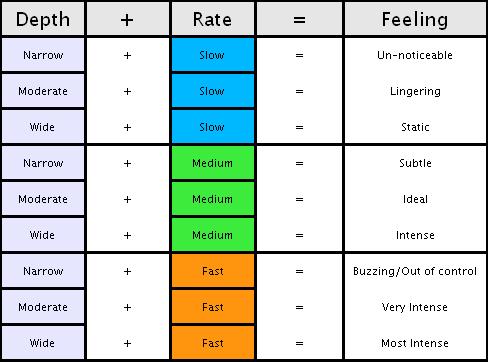
To effectively use these various types of vibrato, try practicing each one until you can calibrate for the appropriate time to use each one.
As a general rule, you will find that using vibrato with moderate range and medium rate will be effective to use in most notes of your guitar phrases. Using narrow/medium vibrato will be useful for slower passages where it is more subtle. In very intense parts of a song or musical phrase, wide/medium and wide/fast vibrato will be very effective in expressing intensity.
Vibrato can sound out of tune if the new pitch (created by the vibrato) is not returned consistently to the original pitch. Make sure to start and end your vibrato in the middle part of the fret. This can also happen when bending the string, and not returning it to the same pitch each time.
To practice being consistently in tune with vibrato, first play the note you are bending to, and then bend to that note. This way it will be easier to hear if you are bending to the correct pitch. Also, you can use an electric guitar tuner to see the exact pitch you are bending to. Practice slowly until it becomes consistent.
Additionally, try applying vibrato to various parts of your guitar phrases to see the effects it generates. Most commonly, vibrato can be effectively applied to the ending of your phrases to help sustain and enrich the overall feeling of a note with a longer duration.
If you'd like to have free access to more high quality guitar lessons, click here. See you soon.
Ysrafel is a professional guitarist, musician, and recording artist who has written articles for many web sites to help thousands of guitarists all over the world, and has created an ongoing instructional series titled "The Electric Guitar Technique Master Series"
He is currently working on various musical projects including his upcoming guitar instrumental album which will contain several different styles such as progressive metal, electronic/dance, and Latin.