
The Guitar Player's Resource
In learning how to play the guitar, or any other instrument for that matter, there are two fundamental concepts that I like to call 'the two Great Divides'. The first one is called 'Divide and Conquer', and it is applied when learning exercises or new pieces of music. Basically, it boils down to dividing the piece in small bits, learn every bit separately and then putting it all together. It also means that you have to isolate the parts that you find more difficult to play so that you can practice them separately (as opposed to try to play through the whole piece of music and stumbling always at the same point). Anyway, this concept has already been beaten to death in many articles available online, so I will not bore you any further on that.
I would like, instead, to concentrate on the second divide, called 'Divide and Multiply', that has more to do with creativity than practice. It consists in taking a music piece apart, much like you did for the first Divide, but then you put the pieces back together in a new, creative way. You can apply this either to whole songs (but this is a topic too big for a single article) or to single licks and soloing ideas. The second Divide is a procedure that has received far less online coverage than the first Divide, but it is not less important - in fact it is vital if you want to develop your own voice. One recent example of the second Divide in action is an article from my friend Paul Tauterouff, showing a simple yet powerful concept in lick building.
I can go on and on describing the second Divide in abstract, I think instead that it is more fruitful if I show you some examples. In the following I will take a single 5-notes scale sequence and show you how much mileage you can get out of a single simple idea. Of course, the variations and licks that I tab here are not the only ones possible: in fact I am pretty sure that after you finish reading this article you will come up with some new variation I did not think of.
IMPORTANT: most of this article will not make any sense unless you try the licks on your guitar!
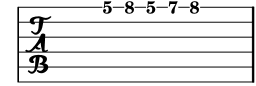
Let us take this sequence of five notes as our basic building block:
 <
<
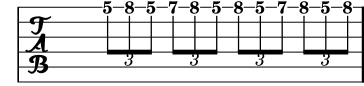
We may have heard this in a solo, or just came up with this while improvising. Either way, we have a basic idea and we want to make it more interesting. The first thing that comes to mind is that you can play this sequence with different time divisions, for instance in triplets:
 <
<
or in quadruplets:
 <
<
or even in quintuplets:
 <
<
Each of these three options has the accents fall on different rhythmic places, making the sequence feeling different. If you want to hear the difference, I prepared a video on my website where I play all the licks in this article and show some tricks on how to nail the different rhythmic divisions.
Just repeating the same notes again and again is not very exciting. The next logical step is to move the sequence around the fretboard. The easiest thing to do is to play the sequence while ascending/descending a scale on a single string. Here I wanted a Neoclassical sound, so I am using the A Harmonic Minor scale. (Blues players, fear not: there will be more blues-sounding examples below and in Part 2). You can play this pattern "straight" while ascending the scale:
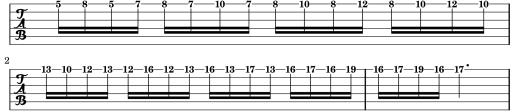 <
<
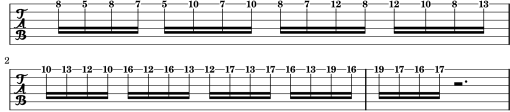
Also, you may 'reverse' the pattern, always while ascending the scale:
 <
<
Here the licks are tabbed in quadruplets, but do not forget that you can play it in triplets and quintuplets too! Of course, you can use both the straight and reverse patterns while descending the scale instead than ascending. Is that all? No! After a bit of experimenting you may realize that you can alternate one straight pattern with one reversed pattern:
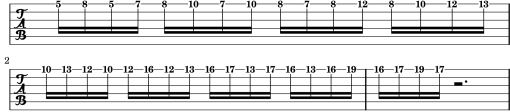 <
<
So far so good, we have seen some application on a single string. Yet the guitar has 6 strings (or more) to work with. This opens a lot of possibilities: let us take an A natural minor scale with the following fingering pattern (the root note positions are indicated with a red diamond):
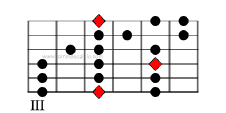 <
<
This pattern has 3 notes per string, which is exactly what we need for our little sequence! So let us apply the straight pattern on a descending scale that way:
 <
<
Notice how playing this lick in quadruplets causes both the accents and the string changes to be 'misaligned' with the beat, making the line more interesting. We can use the reverse pattern too, and the resulting lick is actually one of my favorites, great for flashy song endings. I tend to play it in sextuplets, so here it is:
 <
<
These licks lend naturally to be played in legato instead than picking every note. The muting of unwanted strings is tricky, though. In the free video I prepared I give some tips on how to play the last example cleanly in legato.
We are not limited to a single position on the neck: inserting some scale fragments along with our sequence, here is what can come out:
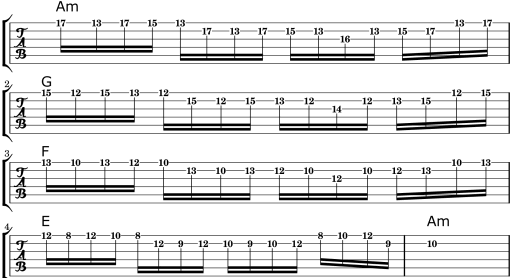 <
<
OK, all is well and good with the minor scale, but I find that for some solo the minor scale is not 'open sounding' enough for my ears. And what about blues? Sure, we can use the mixolydian mode, but would not it be nice to be able to play a sequence like that with a pentatonic scale? Oh yes, it would, but the usual pentatonic fingering is 2 notes per string:
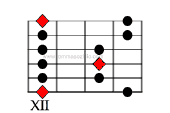 <
<
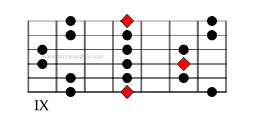
while we need 3 notes per string to make it work. Is there a way to have a pentatonic scale pattern with 3 notes per string? Yes, there is! In fact there are two ways, not only one:
Solution 1: If we want to stay 'in position' like when we played the full minor scale, we can combine two adjacent pentatonic patterns that way:
 <
<
thus obtaining a 3-notes-per-string pattern. A descending scale with the inverse sequence on an E minor pentatonic will become:
 <
<
I find the sound of the repeating notes (like the D on both the first and second string, the A on the second and the third, etc) to be kinda cool. But if you don't like it, we have another option:
Solution 2: We can lay down the pentatonic with 3 notes per string with no repeated notes. The licks become quite more difficult due to the position shift on the neck, but with a bit of practice I am sure you will be able to handle it. This is one possible pattern for the A minor pentatonic laid out on the fretboard:
 <
<
And here is an example of how to play it:
 <
<
That's all for the first part, in the second part we are going to look at the same 5-note sequence in less standard situations. In the meantime, go forth and come up with some interesting licks on your own!
Tommaso Zillio is a professional prog rock/metal guitarist and composer based in Edmonton, AB, Canada.
Tommaso is currently working on an instrumental CD, and an instructional series on fretboard visualization and exotic scales. He is your go-to guy for any and all music theory-related questions.