The Guitar Player's Resource
Welcome back all! I hope you had a chance to take a look at part one of this series of lessons. This time around we'll continue our conversation on the chromatic scale and see how we can apply it in a rock/metal context through our improvisation. Just like any "ingredient" that is in our repertoire too much of one thing can lead to a bad case of indigestion. So while I feel the chromatics are cool its best to use them sparingly so when you do use them people will take notice.
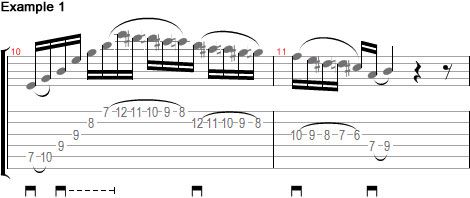
One of my favorite things to do is to combine an arpeggio with a chromatic line. In Example 1 I use the much maligned Emin7 five string arpeggio form. By itself its pretty banal but using it as a staging area for a chromatic line it creates a nice contrast of something familiar with something a bit more out there.
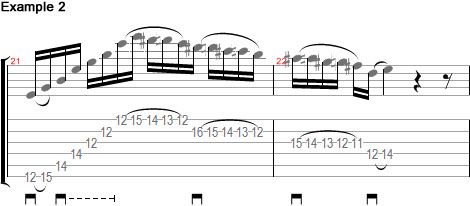
In Example 2 I use the same basic idea as above except I use a six string arpeggio form.
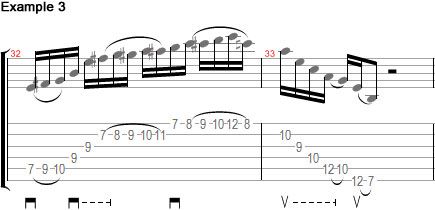
In Example 3 I add a b7 to the E min arpeggio giving it a bluesier quality. Also on the return trip I change over to an Amin7 arpeggio finally ending on B. So in essence I would be playing the ii chord to the vi chord in the key of G.
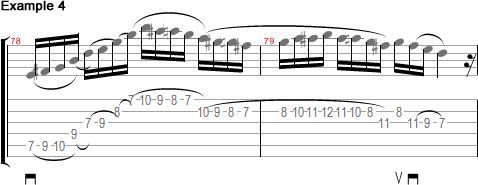
Example 4 again uses the same E min7 arpeggio but I focus more on making the chromatic line a bit more interesting.
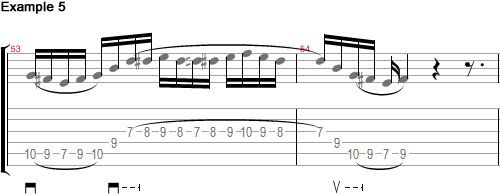
Example 5 takes the above example and shrinks down the arpeggio to 3 strings and focuses more on the chromatic thus giving it a more "fusion like" vibe. I think of Brett Garsed a bit when I hear this line.
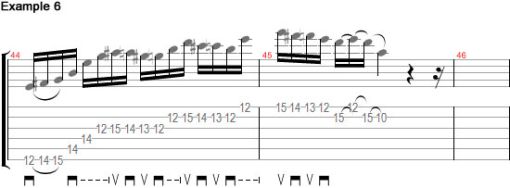
For Example 6 we use the six string form of the E min7 arpeggio and also mix in some economy picking. While the line after the arp is not truly chromatic but more pattern based I think it still gets the point across.
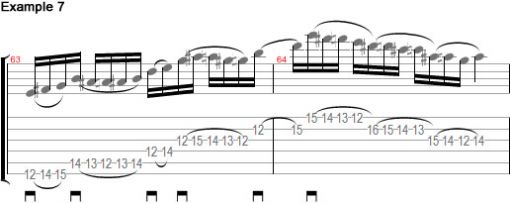
In Example 7 I use the E blues scale as the framework for this line.
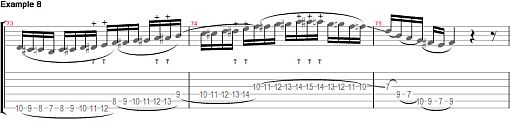
Lastly, in Example 8 I go into the territory of the great TJ Helmerich (two hand tapping guitarist extraordinaire). Please check out his work alongside partner Brett Garsed. The tapping you can use either fingers 1 and 2 or 2 and 3. I prefer 2 and 3 so I can still hold my pick.
I hope these examples can be a nice jumping off point for you to create your own twisted chromatic lines. The are a lot of fun and very useful. Best of luck!
Greg Rapaport is a seven-string guitarist/bassist whose musical focus is a blend of instrumental progressive-metal and jazz-fusion. Greg has been on three tribute CDs (Led Zeppelin, Jeff Beck, Jimi Hendrix - BHP Productions) and has released three critically acclaimed CDs. Greg is currently teaching in upper Westchester County NY.
His latest instrumental CD is entitled "Homunculus".