The Guitar Player's Resource
In this lesson I will be showing you the harmonic minor scale. We will cover the modes, the three note per string fingerings, arpeggios and some basic applications. The harmonic minor scale has a classical flavor to it, but you can use it in any style of music. This scale has a distinct sound to it and it is important to get the sound of it in your ear. Many well known composers use this scale in their writing. Let's cover some of the basics of this scale.
The minor third interval between the 6th and 7th degree creates the classical flavor to the scale. The formula of this scale is (1, 2, b3, 4, 5, b6, 7). It is important to memorize the formula so you can construct it in any key.
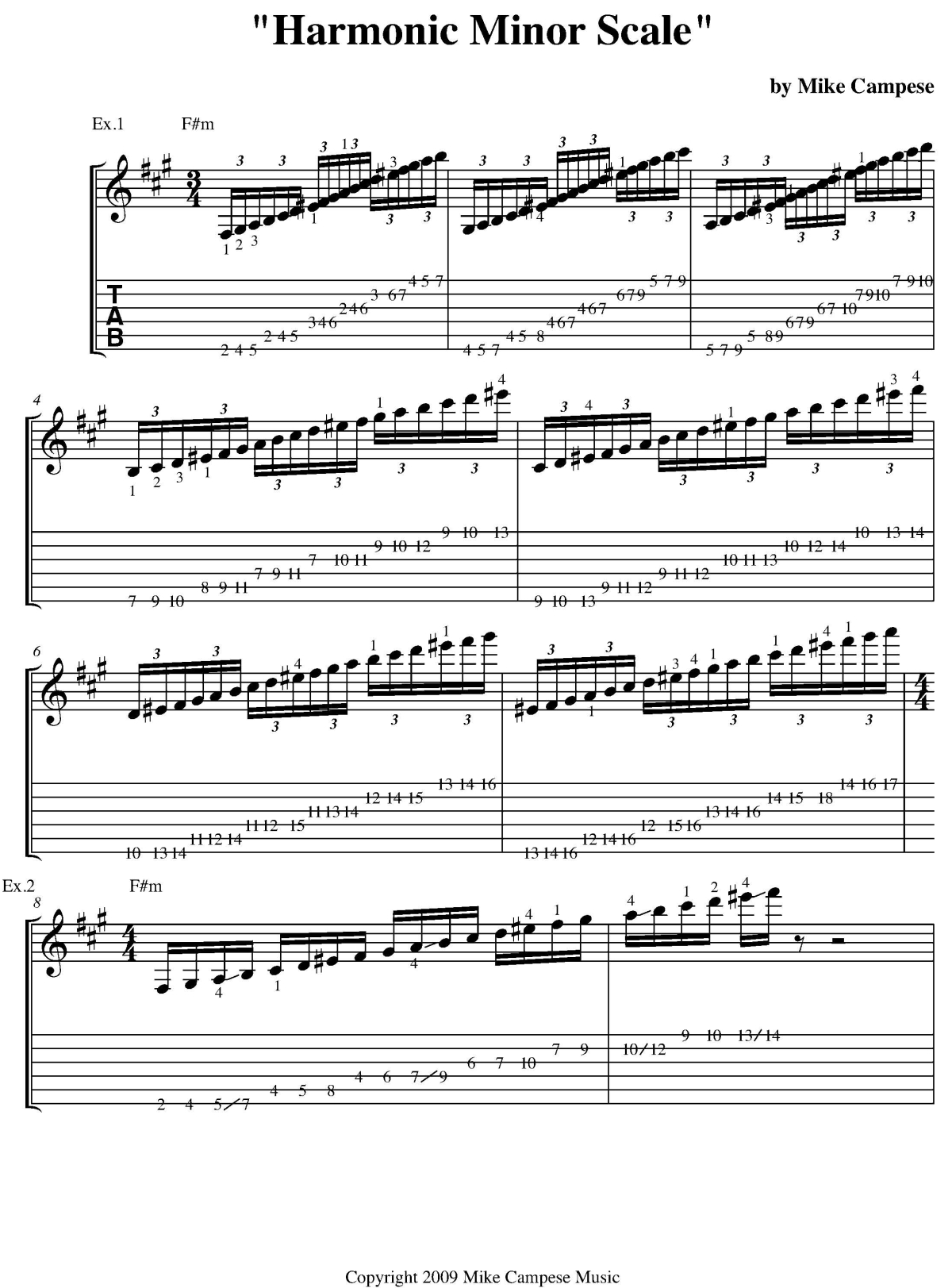
Example 1 is all 7, 3 note per string patterns of the harmonic minor scale. They are in the key of F# (F#, G#, A, B, C#, D, E#) be sure to move them around once memorized and make up your own ways to play them. Example 2 is a extended version of the scale that moves across the neck. Notice the pattern that moves up each octave is the same for all 3 octaves. When playing this ascending your pinky slides up the neck and descending your index finger slides down the neck. You might want to follow the suggested fingerings.
MP3 - Example 1
MP3 - Example 2
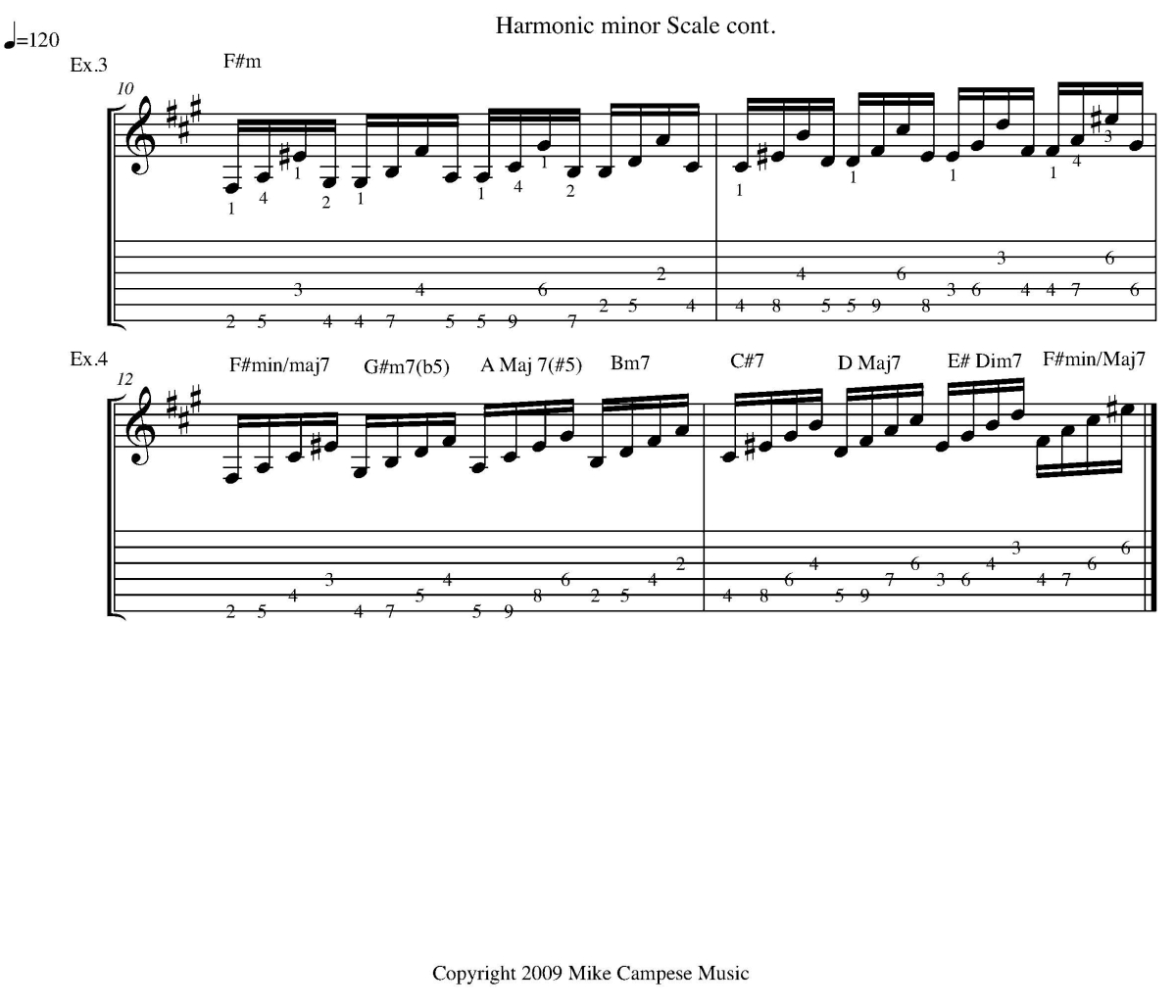
Once the fingerings are memorized you is a good idea to practice this scale using scale sequences. Instead of giving you common sequences to practice and send you on your way, I have decided to give you a more challenging one like in Example 3. This is not your common sequence, this a more intervallic approach. This pattern is based off a minor 3rd interval and a major 6th interval, moving up the F# harmonic minor scale. Basically, you go up a minor 3rd, then move up 5 notes from where you are at in the scale, then down a major 6th. Depending on where you are at in the scale the interval will be a minor 6th instead of a major 6th.
It is very important to know what chords are diatonic to the scale; the left column contains the diatonic triads and the right column displays the 7th chords. You can also play these as arpeggios, like in example 4, play these in different positions.
| minor | minor maj7 |
| diminished | minor 7th (b5) |
| augmented | augmented major 7th |
| minor | minor 7th |
| major | dominant 7th |
| major | major 7th |
| diminished | diminished 7th |
MP3 - Example 4
Here is a list of modes of the harmonic minor scale. Be sure to memorize these and play them in all keys. Phrygian dominant is one of the most used modes from this scale and you will notice it has a Spanish flavor.
Harmonic Minor=1, 2, b3, 4, 5, b6, 7
Locrian Natural 6=1, b2, b3, 4, b5, 6, b7
Ionian Augmented=1, 2, 3, 4, #5, 6, 7
Dorian #4=1, 2, b3, #4, 5, 6, b7
Phrygian Dominant=1, b2, 3, 4, 5, b6, b7
Lydian #9=1, #2, 3, #4, 5, 6, 7
Altered Dominant bb7=1, b2, b3, b4, b5, b6, bb7
This scale is commonly used over dominant chords like a V7 to I progression, for example G7-Cm. Try recording this progression and play the C harmonic minor scale over the G7, this will bring the sound of the 5th mode phrygian dominant and over the Cm use the C natural minor scale. You can also play the harmonic minor over the Cm, but you will notice the harmonic minor works better with the dominant, it is up to you to experiment. Try recording just a Dominant chord and play the harmonic minor off the root. You can also use this scale over the chords that are diatonic to the scale. In a rock situation, try playing power chords off each note of the scale and instead of playing the 7th chords you can just play the triads. There are many more applications you can do with the harmonic minor scale.
That wraps up the lesson. Be sure to spend time exploring the harmonic minor scale and use it in your playing. Be sure to check out my CDs on this amazing site and visit mikecampese.com for more information.
Mike Campese is an all-around music performer, session artist and teacher competent in many musical styles, electric and acoustic. He has studied at G.I.T. (Honors Graduate), and with Paul Gilbert, Norman Brown, Stanley Jordan, Scott Henderson and Keith Wyatt.