
The Guitar Player's Resource
One of the most popular techniques for lead guitar playing is tapping. Many guitarists have a good idea of how tapping works, and can play basic tapping licks. However, in order to begin to play larger, more advanced tapping patterns, you will need to be able to transfer from one string to the next. This will expand the amount of potential notes in your patterns. While playing patterns on the guitar and moving from one string to the next, you will always be playing either a Vertical or a Diagonal pattern. This can also be referred to as a "Vertical/Diagonal movement" or "transfer."
By using both Vertical and Diagonal patterns together, you will be able to greatly increase the amount of area you can take up on the fretboard, and the amount of variations and sequences you can play with the same exact notes (played in a different fretboard position) or with different notes. In this article I will be looking at this concept from the perspective of expanding tapping technique.
So, what are vertical and diagonal patterns?
A Vertical Pattern means that when you transfer from one string to the next, you will be staying in the same fretboard position in your fretting hand. Since you are staying in the same fretboard position, this limits you to only be able to transfer in a vertical manner when you go from one string to the next.
MP3 - Example 1
When moving from one string to the next this pattern stays in the same fretboard position (12th position).
A Diagonal Pattern means that when you transfer from one string to the next, you will NOT be staying in the same fretboard position in your fretting hand. This means that you will be moving 1 or more fretboard positions away when you transfer to the next string of a pattern.
MP3 - Example 2
Moving in a Vertical or Diagonal manner can also refer to the change of position made in the tapping hand while tapping patterns. In addition, note that some patterns can have stronger Vertical or Diagonal movement than others. Notice in this pattern that the tapping hand is constantly moving in a diagonal manner (strictly diagonal movement), while the frethand moves diagonal from the "A" string to the "G" string, and then back to the original fretboard position when going from the "G" string to the "E" string (containing both vertical and diagonal movement, making it less diagonal).
Two things that many players struggle with is transferring from one string are:
1. Connecting the patterns on each string together in a smooth controlled manner.
2. Keeping other strings or excess noise from sounding while transferring.
If you want to play with clean technique while transferring from one string to the next, knowing how to correct these problems is knowledge you need to have. To see a video explanation of how to transfer cleanly from string to string when tapping, sign up for Ysrafel's free newsletter here.
MP3 - Example 3
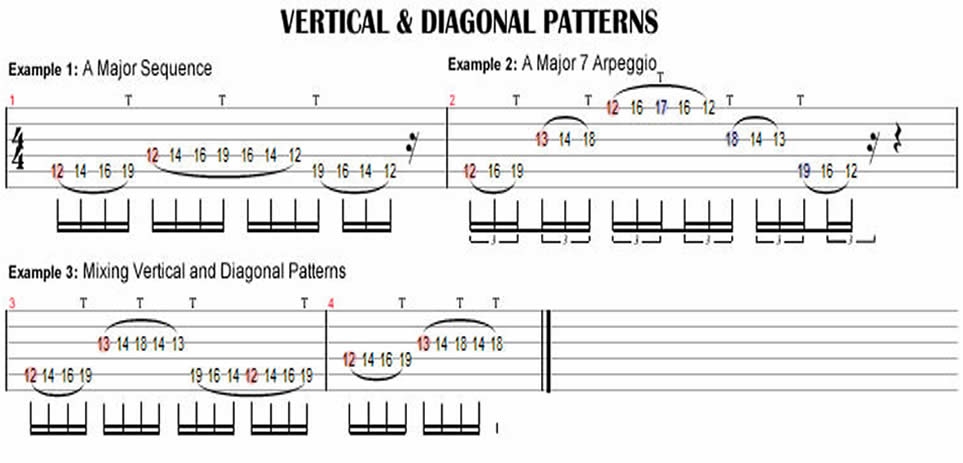
The exercises in this article are only a small sample of what you can do with Vertical and Diagonal string transfers . This concept is applicable to guitar playing in a general sense, and covers anything you can do on the fretboard. It applies to non tapping techniques such as sweep picking, alternate picking, economy picking, directional picking, etc. Make sure to experiment on the guitar by finding different fretboard positions to play the same scales or arpeggios. There are endless combinations of notes and note patterns that can be achieved by combining vertical and diagonal patterns together. The more you can mix and match these patterns, the more command you will have over the fretboard.
Ysrafel is a professional guitarist, musician, and recording artist who has written articles for many web sites to help thousands of guitarists all over the world, and has created an ongoing instructional series titled "The Electric Guitar Technique Master Series"
He is currently working on various musical projects including his upcoming guitar instrumental album which will contain several different styles such as progressive metal, electronic/dance, and Latin.