The Guitar Player's Resource
In this lesson I will be showing you a great technique I like to use in my playing, which will help you break the monotony of running up and down scales and help add an interesting flavor to your playing. This technique is called Octave Displacement, also known as Octave Dispersion. It means placing notes in different octaves without following a particular order. You can experiment with this technique using scales, arpeggios, licks, and even chords.
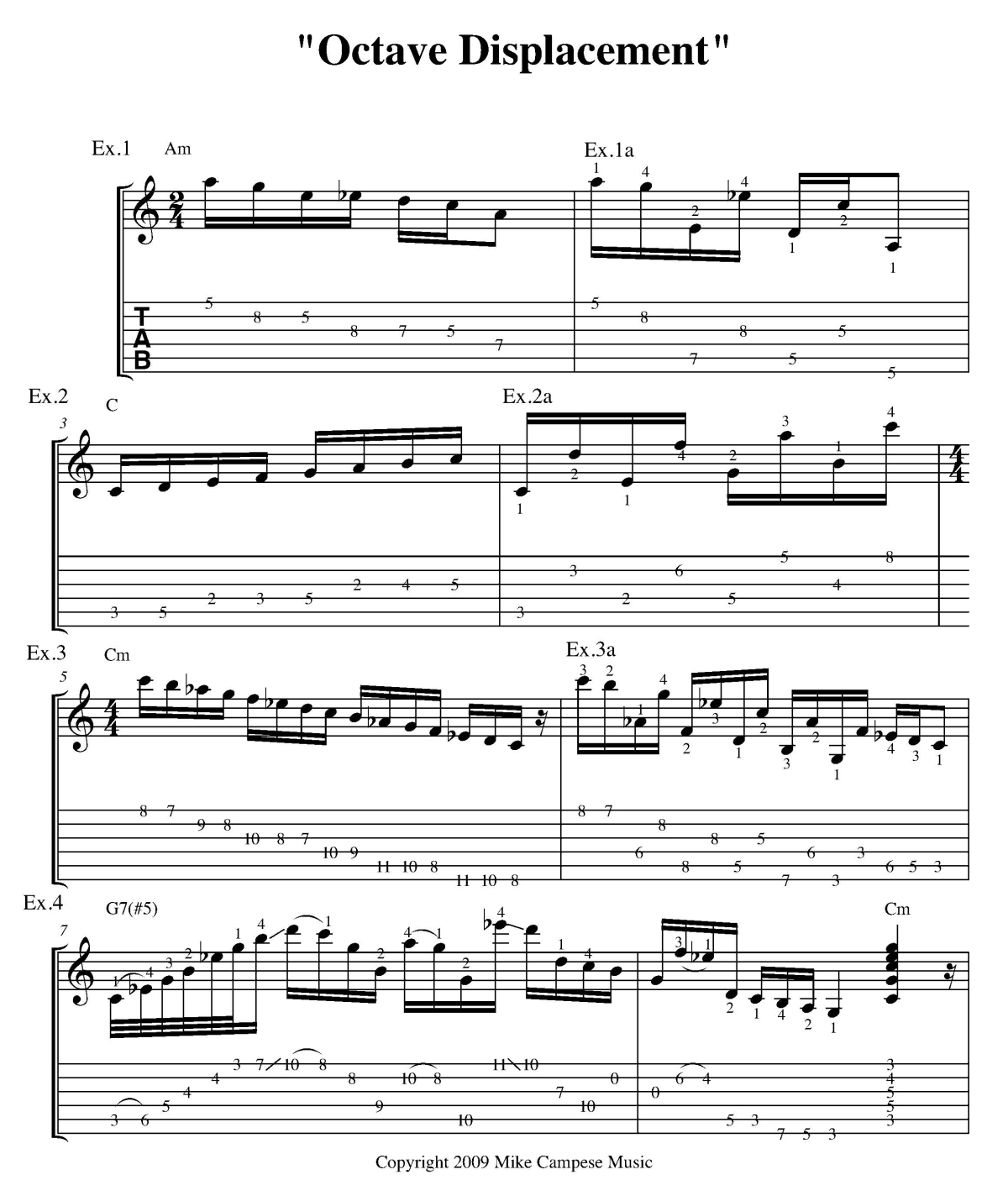
Examples 1 and 1a. Let's take a basic descending A Blues scale (A, C, D, Eb, E, G). In this example, the first two notes stay in the same octave, then the third note will jump down an octave, the fourth note will stay in the same octave, etc. There is no set rule to which notes you can move, you have to experiment.
MP3 - Examples 1 and 1a
Examples 2 and 2a. Now let's take a basic C Major scale (C, D, E, F, G, A, B). For this example, I'll move every other note up an octave. This can be tricky for the right hand, but it adds a neat effect.
MP3 - Examples 2 and 2a
Examples 3 and 3a. Here is a descending C Harmonic minor scale (C, D, Eb, F, G, Ab, B). This one follows the pattern we have been using all along. The first two notes are in the same octave, and then it alternates with every other note down an octave. The last three notes I left alone; be sure to follow the fingerings supplied.
MP3 - Examples 3 and 3a
Example 4. Now let's apply this technique to a musical situation. This lick I put together is based on the C Melodic minor scale (C, D, Eb, F, G, A, B). This lick kicks off on the very first beat with a Cm(Maj 7) arpeggio (C, Eb, G, B). I use sweep picking to play this arpeggio, but you can pick every note if you want. Also, you will notice open strings in this lick, open strings can really help you get across the neck very quickly, while adding a neat effect.
MP3 - Example 4
That wraps up the lesson. Be sure to make up your own examples based on what I have given you. Be sure to check out my CDs on this amazing site and visit mikecampese.com for more information.
Mike Campese is an all-around music performer, session artist and teacher competent in many musical styles, electric and acoustic. He has studied at G.I.T. (Honors Graduate), and with Paul Gilbert, Norman Brown, Stanley Jordan, Scott Henderson and Keith Wyatt.