
The Guitar Player's Resource
Welcome back! In this lesson I will be briefly showing you the melodic minor scale, how it is used, applying it etc. The melodic minor is used in different styles of music, you may hear it a lot in jazz and classical, and you can easily apply it to rock. In this lesson I will just show you a couple of fingerings, the modes, the chord scale arpeggios and a few lines you can practice to get you started. It is really important to get the sound of the scale in your ear so you can easily apply it to your playing and play it all over the fingerboard. Let's get started.
You can look at the melodic minor as a major scale with a lowered 3rd, or you can take the Dorian mode and raise the 7th. The formula of this scale is (1, 2, b3, 4, 5, 6, 7). In classical music, the melodic minor is played ascending, and the natural minor descending. In this lesson we will be using the modern improvising approach; the scale is the same ascending and descending. It is very important to memorize the formula so you can construct it in all keys.
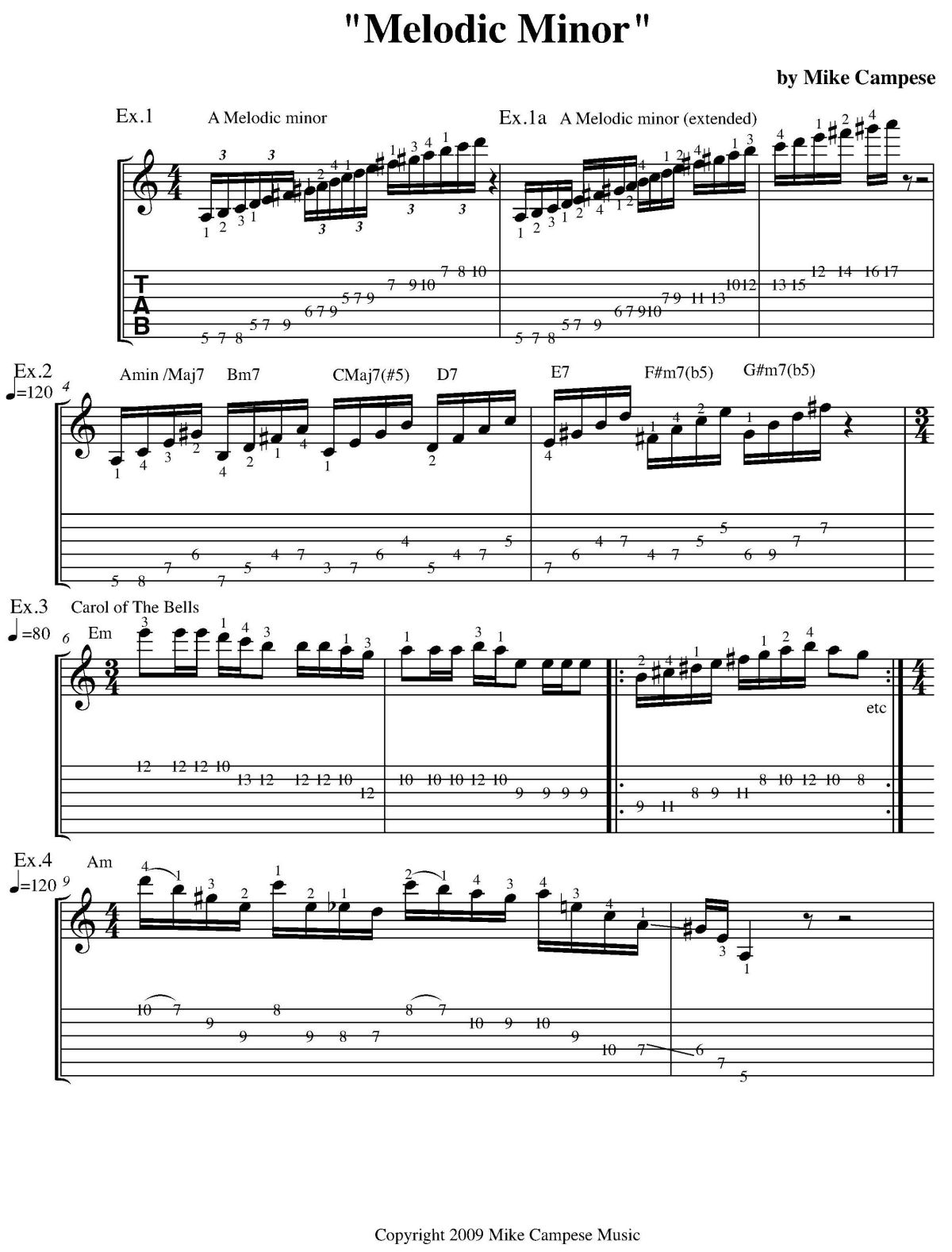
I will just be showing you a couple of fingerings in this lesson to start you off. Example 1 is a three note per string pattern in the key of A melodic minor (A, B, C, D, E, F#, G#); this pattern works off the 6th string in every key. Example 1a is the same scale played in a extended version across the neck. A great exercise is to play the same scale different ways ascending and descending. For example, if you are in A melodic minor, play up to the highest A on your guitar and descend back down to A in a different way.
MP3 - Example 1
MP3 - Example 1a
It is important to learn the chords and arpeggios for the melodic minor scale. Example 2 is the 7th chord arpeggios in the key of A; this pattern is the same in all keys. It is really simple to harmonize scales, just stack every other scale tone. Make sure you play them all over the neck.
MP3 - Example 2
Here are the list of modes from the melodic minor. Make sure you memorize the formulas for each one and play them in different keys, just like you would with the major scale modes.
Melodic Minor = 1, 2, b3, 4, 5 ,6 ,7
Dorian b2 = 1, b2, b3, 4, 5, 6, b7
Lydian Augmented = 1, 2, 3, #4, #5, 6, 7
Lydian b7 = 1 ,2, 3, #4, 5, 6, b7
Mixolydian b6 = 1, 2, 3, 4, 5, b6, b7
Locrian Natural 2 = 1, 2, b3, 4, b5, b6, b7
Super Locrian = 1, b2, b3, b4, b5, b6, b7
There are many ways, but I will just show you a few. To start off, record yourself playing a Am chord vamp for a while, and play the A melodic minor over it. Also, try mixing the A Dorian scale (A, B, C, D, F#, G) with the A melodic minor; you will notice the only difference is the G#, the raised 7th.
A lot of popular melodies use the melodic minor, a really great example is the Christmas song "Carol Of The Bells" in Example 3. You may want to check out my version of "Carol Of The Bells" off my latest CD, "The Meaning Of Christmas". The first 2 measures are from the E natural minor scale (E, F#, G, A, B, C, D) and then bar 3 switches to the E melodic minor (E, F#, G, A, B, C#, D#) starting from the 5th mode B Mixolydian b6.
MP3 - Example 3
Here's another great way to use the melodic minor scale. Record a D7 chord and play D Lydian b7 over it, which is the same as A melodic minor. This approach can work well in a blues progression.
Be sure to make up lines using this scale so you can apply it to your playing. Example 4 is a line that I constructed that mixes the A blues scale (A, C, D, Eb, E, G) and the A melodic minor. You might want to follow the suggested fingerings.
MP3 - Example 4
OK, that's it for now, I just gave you a few examples to start you off. Be sure to check out my CDs on this amazing site and visit mikecampese.com for more information.
Mike Campese is an all-around music performer, session artist and teacher competent in many musical styles, electric and acoustic. He has studied at G.I.T. (Honors Graduate), and with Paul Gilbert, Norman Brown, Stanley Jordan, Scott Henderson and Keith Wyatt.