
The Guitar Player's Resource
In this lesson I am going to show you how to create your own licks using hammers and pulls combined with open strings. I like to use this technique during improvisations to create interesting, fast pedal point licks with wide intervals.
I am demonstrating this concept using the Lydian Mode in the key of E, but you can use this technique with any mode or scale including the Pentatonic Scale. So, do not just memorize the licks I am demonstrating. This lesson will be of the greatest benefit to you if you take the concept and use it to generate your own ideas in different keys and with various scales.
So with that in mind let's get started!
Here is a typical two-octave Lydian Mode (in E) pattern played at the 12th fret.
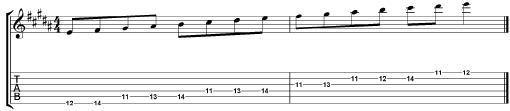
Let's take a look at the notes of the E Lydian Mode.
They are: E, F#, G#, A#, B, C# and D#.
If we analyze these notes we see that E and B are the only two scale tones that are available on open strings. So let's lay out our E Lydian Mode on the B string.
The frets we will use on the B string will be:
Open (B), 2nd (C#), 4th (D#), 5th (E), 7th (F#), 9th (G#), 11th (A#), 12th (B), and 14th (C#) fret.
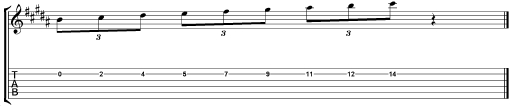
Example 1 is the ascending version of the basic idea: you pick the open B string and then hammer the next two notes. Due to the small amount of picking involved it's very easy to play this lick at a fast speed and achieve a very fluid sound.
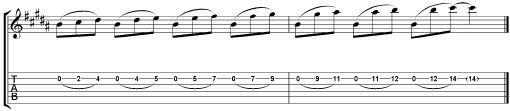
Example 2 is the descending version. Notice that even though we are working our way back down the neck of the guitar we are still using ascending hammers.
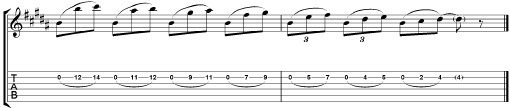
To recap - here's how you would use this in your own improvisation:
This concept may seem a little complicated at first, but if you have good scale knowledge you should be able to quickly implement this into your playing. Knowledge of scales and modes is essential to creating great solos, so if you find yourself lacking in this area I recommend you brush up on this.
I hope you have enjoyed this lesson and that you have found it helpful for generating new ideas for soloing. Experiment with this concept using other scales and other keys, but most importantly have fun. If you enjoyed this article I invite you to sign up for my free newsletter at paultauterouff.com. Each month I include a free guitar lesson along with links to cool resources for guitarists.
In Part II of this lesson I will show you some ways to expand this idea further to create even less predictable sounding licks. Happy jamming and thank you for your interest and friendship!
Paul Tauterouff is a professional musician and guitar teacher in upstate New York.
His CD "Audio Chocolate" sold for many years on the Guitar Nine site.