
The Guitar Player's Resource
Happy New Year! In this lesson I will be showing you how to play three octave arpeggios across the neck.
After you learn your basic arpeggio shapes using one or two octaves and you are looking to get to the next level, you must learn to use the full range of the neck. We will start off by using three note triad arpeggios and then four note arpeggios like Maj7, min7 and Dom7. All you do is repeat the same notes up the neck in all three octaves. For example, if you are playing a B major arpeggio (B, D#, F#) in three octaves you will be using only those three notes continuously. The key is to map out the notes so you can move smoothly across the neck. There are several ways you can play the same notes. I'll just be giving you some examples to show you the concept; these are some of my favorite variations. Be sure to follow the fingerings and then experiment with your own. This works in all keys and with any arpeggio type.
Example 1 features a G Major arpeggio (G, B, D) in three octaves. This is one of my favorite ways to play this arpeggio, you can really fly across the neck very quickly. There are many ways you can play the same notes on the fretboard, try shifting to different strings to work your way up the neck. Also, be sure to follow the fingerings provided, you can use the same fingerings descending.
MP3 - Example 1
Example 2 is a three octave G minor arpeggio (G, Bb, D), very similar to the G Major, but with a flatted third. I like to alternate pick these arpeggios, but you can experiment with sweep picking. You can hammer the first two notes and then sweep pick the rest - there are many ways you can do it.
MP3 - Example 2
For Example 3 we'll be adding the 7th; this is a G Major 7th (G, B, D, F#). I really like the sound of these. To play these quickly, you have to slide the 7th to the octave. You can experiment with different fingerings.
MP3 - Example 3
Example 4 features a real cool way to play a G minor 7th arpeggio (G, Bb, D, F). You will notice this arpeggio is very similar to a minor pentatonic scale; the difference between the minor 7th arpeggio and the minor pentatonic is that the 4th is left out.
MP3 - Example 4
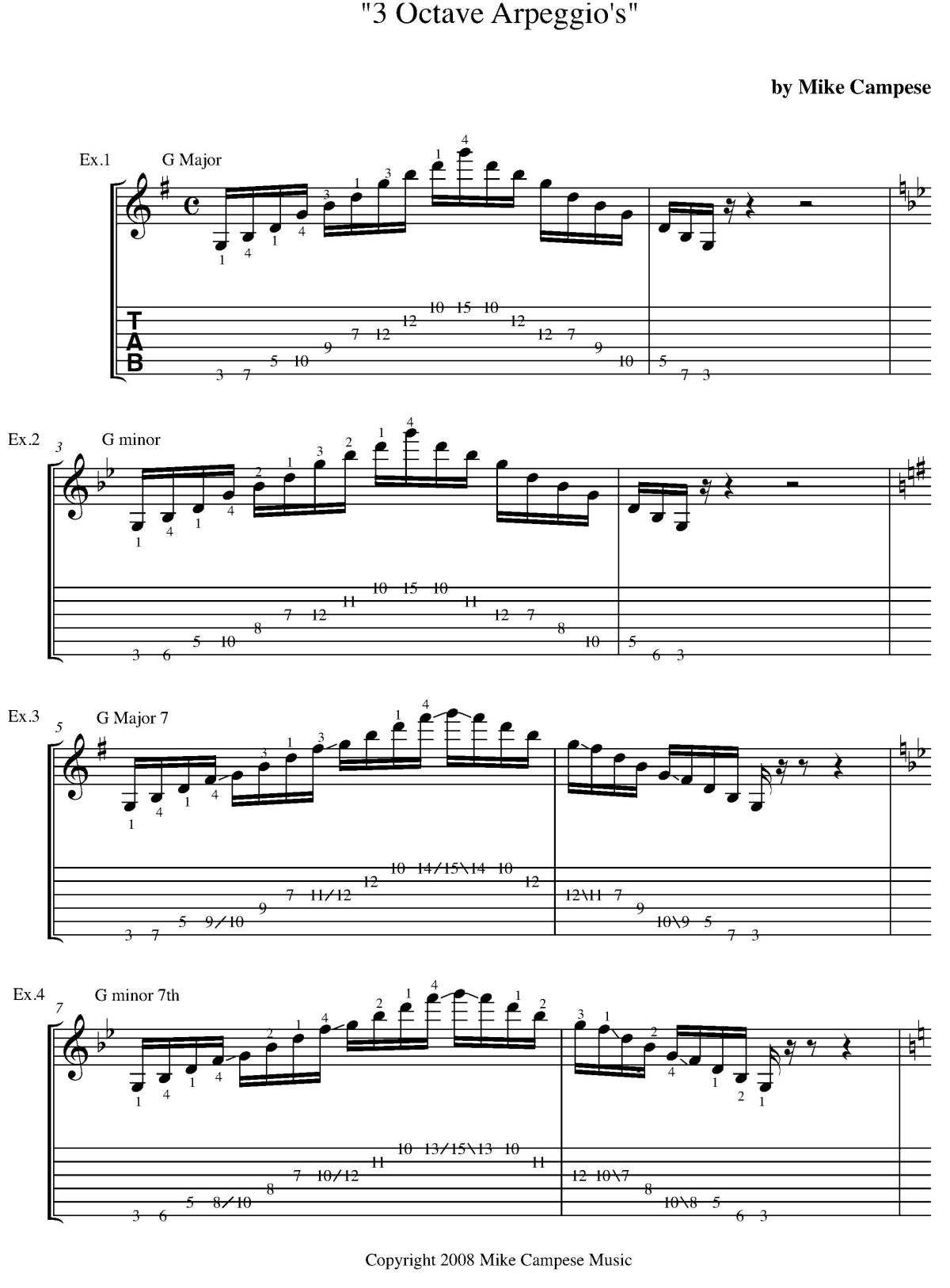
I've just shown you one way to play these examples; there are, of course, several ways to play three octave arpeggios. By practicing this way you can really learn the notes on the neck and the notes in each arpeggio. Also, this can really develop your ear.
Be sure to check out my CDs on this amazing site and visit mikecampese.com for more information.
Mike Campese is an all-around music performer, session artist and teacher competent in many musical styles, electric and acoustic. He has studied at G.I.T. (Honors Graduate), and with Paul Gilbert, Norman Brown, Stanley Jordan, Scott Henderson and Keith Wyatt.