
The Guitar Player's Resource
Note: Prior knowledge of the five Minor Pentatonic box patterns and the 7 modal shapes is helpful for understanding this lesson, but not absolutely necessary.
Objective: To help guitarists already familiar with the pentatonic scale to learn and utilize the modes in their lead guitar playing.
As a guitarist, I am primarily self-taught and didn't have any formal music theory training in the early stages of my playing. The first scales that I learned were the five positions or box patterns of the minor pentatonic scale. I wrote the diagrams out by hand, and would play (and draw) them constantly.
When I was first exposed to the seven modes of the major scale, I did the same thing; sketched the fretboard diagrams, studied how the shapes fit together, etc. Even after I had the modal shapes memorized, I was still having a difficult time actually applying them to my lead playing. Seven shapes just seemed like too many after becoming so accustomed to the five box patterns of the pentatonic scale.
Then I came up with an idea: What if I divided the modes of the major scale up into 5 scale chunks, based on the five Minor Pentatonic box patterns that I was already comfortable with? This way I would only have to add a couple of new notes to each of the 5 pentatonic boxes! For lack of a better name, I've decided to call this the Pentamodal Idea.
To demonstrate, let's work out an example for a scale which is commonly used in rock guitar lead playing - the 6th mode of the Major Scale, Aeolian mode (a.k.a. the Natural Minor scale). The following examples are in the key of A minor.
Here is our 1st Pentamodal shape, Aeolian Mode:
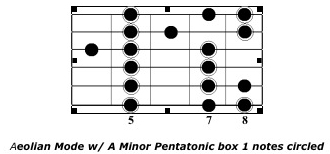
We will skip Locrian, the mode that would normally follow Aeolian, since its first note (B at the 7th fret of the low E string) does not align with our A Minor Pentatonic scale box patterns.
This brings us to Pentamodal Pattern #2, Ionian Mode:
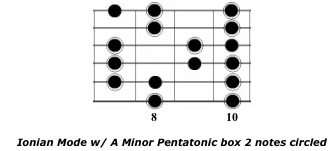
Note: Keep in mind that even though we may have skipped over the Locrian Mode, its notes are still available for us to use in our soloing via patterns 1 and 2, we just aren't thinking of it as its own individual shape or box pattern.
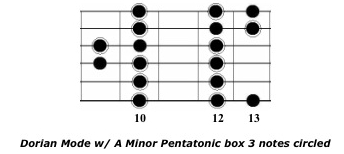
Continuing in order, Pattern #3 consists of the Dorian shape:
Next is Pattern #4, which includes the Phrygian mode:
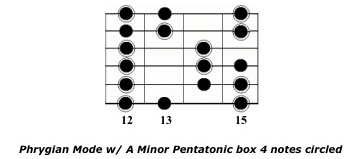
We will skip the mode that would normally follow Phrygian, (Lydian) because its first note does not align with the Minor Pentatonic scale box pattern in our A Aeolian-based example.
This brings us to our 5th and final pattern, using the Mixolydian mode:
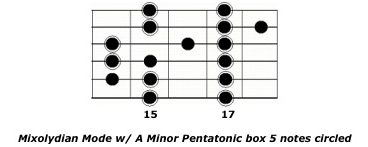
1. Remember, we're still playing all of the notes of the seven modes, we've just chosen to break them up into 5 box patterns - like our minor pentatonic scales.
2. The above patterns will also work for a C Ionian (Major) root, since it is the relative major of A Aeolian Mode.
3. Depending on which mode we choose to be our #1 (root) or parent scale, different modes may be skipped over. For example, if A Dorian minor was our #1 scale, we would skip Phrygian (at B, the 7th fret of the low E string) and Lydian would be our #2 shape, at the 8th fret (the C note).
4. This is a "quick-and-dirty" method for assimilating the modes into your playing. Once you become familiar with using these shapes, I highly recommend also working out and memorizing the three note-per-string patterns for the modes. Box patterns are great for breaking ideas into small, easily digestible pieces, but you don't want to be limited by them either.
I hope this lesson helps you to begin to implement modal sounds into your playing.
Paul Tauterouff is a professional musician and guitar teacher in upstate New York.
His CD "Audio Chocolate" sold for many years on the Guitar Nine site.