
The Guitar Player's Resource
When the amps are turned to 10 and the distortion pedal is as loud as possible, every little nuance shines through and you'll need as much help as possible to alleviate any unwanted noise. In this lesson, I'll show you some muting techniques for both your left and right hands to help miminize fret buzz and sounding unwanted strings while still being able to play all 6 strings all of the time. Here is the chord chart for a B minor chord which we'll be using as an example in this lesson:
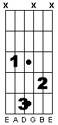
Most of the time, when notes are played by accident, it's because of the placement on your fret hand. When playing certain chords, the placement of your fingers when fretting the notes is imperative to not only playing those desired notes but also muting the unwanted strings. Take a look at Example 1.

Here you'll see my hand playing a simple B minor chord. Notice how the tip of my index finger just barely touches the low E string but there's enough contact to mute that particular string. The G string is also muted by allowing the fleshy part of my ring finger to "rest" against it so it will not sound. The high E string is also muted by my index finger but uses the bottom part of my finger near the palm.
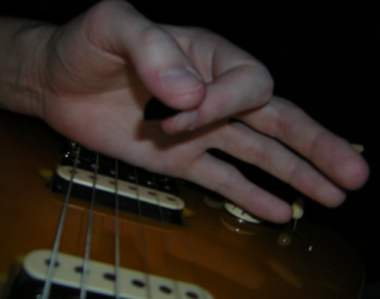
In example 2, my pick/ strum hand mutes the unwanted strings by gently placing the side of my palm on the strings near the bridge. In most instances, pick handed muting occurs during solos or lead playing. You will hear the muted notes for a split second but it won't impede on your playing. If anything, it will create a more percussive sound which can be used to your advantage, especially when you're playing by yourself.
The last example, Example 3, is a video that shows you how to use both your left and right hands to mute your strings while playing in real time. It's a quick example but one that should that help you understand the concept in an actual playing situation.
This technique, like most, gets easier with time. Hopefully, it'll be something you can use at all times and not have to even think about. Start muting with your fret first and then move on to your picking hand. Take it slow and then develop it. Best of luck.
Patrick DeCoste is a Boston area guitarist whose original music on his debut CD features well-rounded exploration, tasty lines and burnished production, giving one's imagination license to wander..
His latest CD is entitled "Inside The Unsaid".