
The Guitar Player's Resource
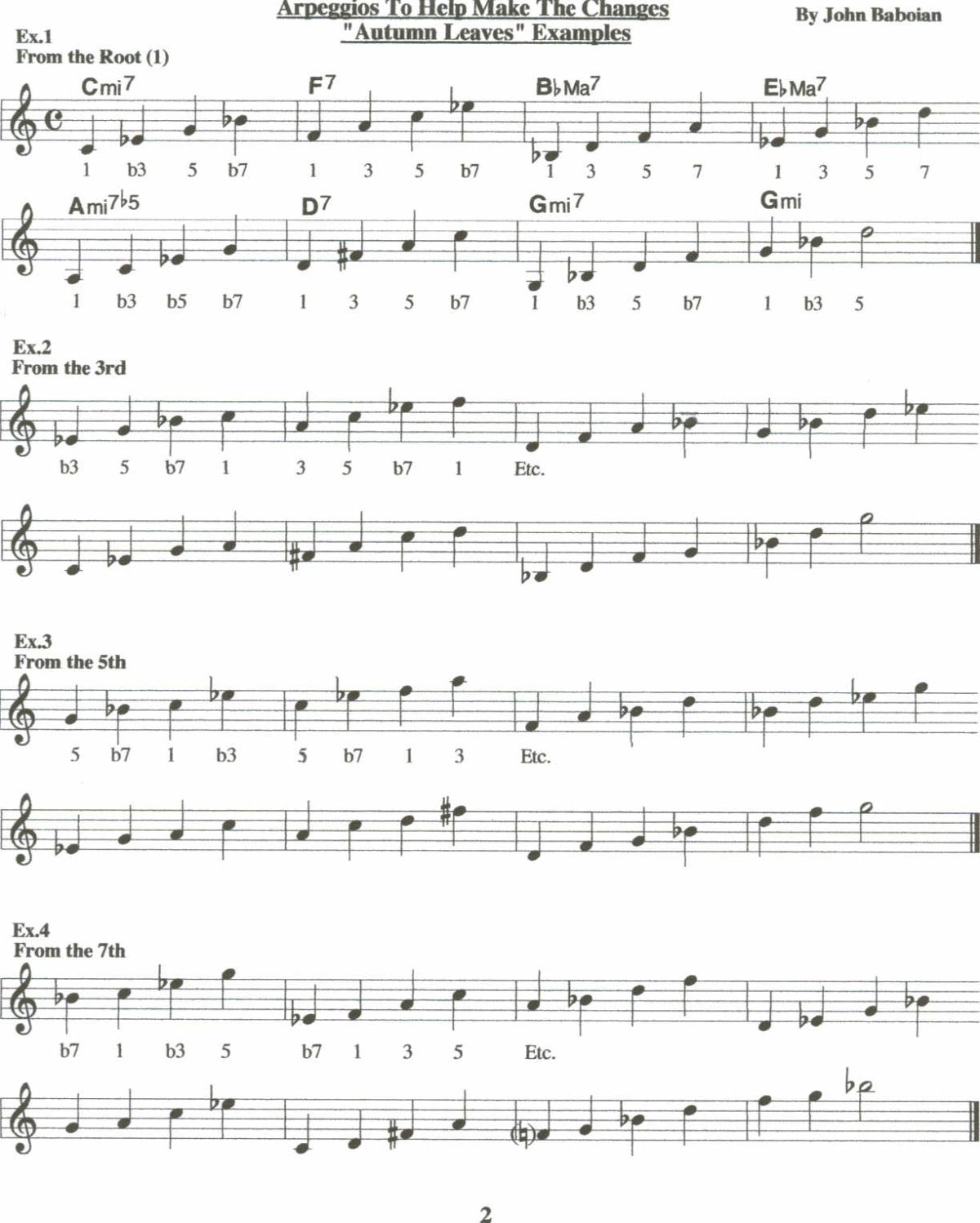
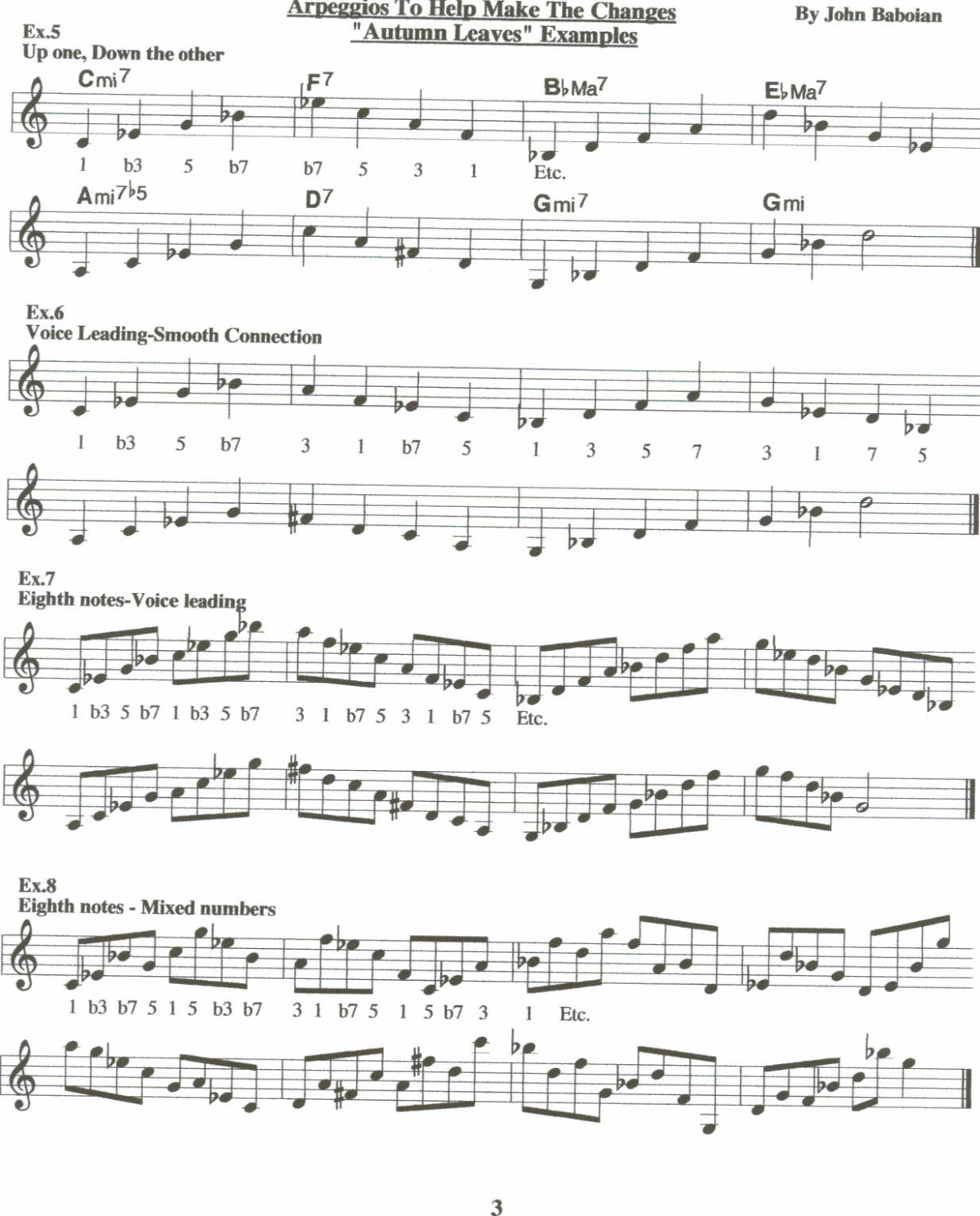
I find that inexperienced guitarists who are learning how to improvise over chord progressions, especially "rock" oriented players trying to put some "jazz" into their playing, tend to play quite a few "wrong notes" on their way to creating interesting improvisation lines. One way to help with that problem is to take common chord progressions from standard songs, and simply apply the arpeggios of the chords to the progression. Arpeggios are the notes of a chord played, or spelled out, one note at a time.
For example:
Major7 = 1 3 5 7 -- Cmaj7 = C E G B
Dominant7 = 1 3 5 b7 -- Cdom7, usually referred to as C7 = C E G Bb
Minor7 = 1 b3 5 b7 -- Cm7 = C Eb G Bb
Minor7b5 = 1 b3 b5 b7 -- Cm7b5, also called 1/2 diminished = C Eb Gb Bb
You can apply the same principle to any chord type, in any key, and should certainly be practiced regularly, both mentally without the instrument, and physically on the instrument.
My reason for starting with maj7, dom7, min7, and m7b5 is that these are the most common four note chords, and are seen in the most common jazz standards. As an example, we will look at the chord progression from the first eight bars of the standard song "Autumn Leaves" by Joseph Kosma and Johnny Mercer, a song that many young jazz musicians learn early on because of it's simplicity. This progression is also found in other standards like Michelle LeGrande's "Yesterday, When I Was Young", and Carlos Santana's "Europa".
The arpeggio examples that you will see on the following pages start out with quarter notes and then move on to eighth notes. They begin by using the root as the first note of the arpeggios. As the examples progress, different variations are presented. There is an endless variety of exercises that you can try simply by messing up the numbers of the chord tones. Use these pages as a starting point and come up with excercises of your own creation.
John Baboian has been on the faculty at Berklee College of Music in Boston since 1980. Before beginning his teaching career at Berklee, he received his bachelors degree from the school and later received a masters degree from New England Conservatory Of Music.
His compositions and arrangements have been heard on television shows "Walker, Texas Ranger", UPN's "Seven Days", and HBO's "The Soprano's".
Baboian is a member of the "Be-Bop" Guitars, an all-faculty band from Berklee.