The Guitar Player's Resource
One of the things I am asked most by students is how they can improve their soloing. Many people feel learning as many scales as they can and having the ability to play those scales in any key in all positions is the answer. While I feel those are all necessary steps in becoming a proficient lead guitarist, it is also just the tip of the iceberg when it comes to playing interesting, musical solos that will keep a listener engaged and wanting to here more. Not only do you need to know the notes, you need to figure out what to do with them. In this column, I would like to discuss some of the concepts I try and apply to my solo's to hopefully keep them interesting and musical. Also, I will dissect the solo from the song "Face Card" from my debut CD "Orbit".
One of the most important things to constructing a solo that will keep somebody interested in what you are playing is using variety. Variety in the notes you use, variety in the rhythm you use to play those notes, variety in the amount of space you leave between phrases, variety in techniques you apply to those notes etc. Having said that some of the things that I think about and try to vary when improvising or constructing a solo are as follows:
1. Use of rhythms
2. Use of space
3. Use of techniques (bends, slides, hammers, pulls etc.)
4. Use of speed
Using variety would imply that you not overuse any one technique, not use the same amount of space between every phrase, not use the same techniques and not playing fast all the time. For instance, choosing a note to bend and simply bending it with the same rhythm, or the same amount every time you hit that note would cause the bend to grow rather tiresome to listen to. Another example would be to play very fast through a whole solo. Some players feel that because they can play fast they should do so all the time. In reality, fast playing, placed strategically in a solo among some slower phrases, will, in a lot of situations be more interesting to listen to.
I would now like to illustrate how I used variety in many ways to play the solo in the song "Face Card". I have included the full transcription, along with an mp3 of the solo as it appears on my CD "Orbit".
MP3 - "Face Card" Solo
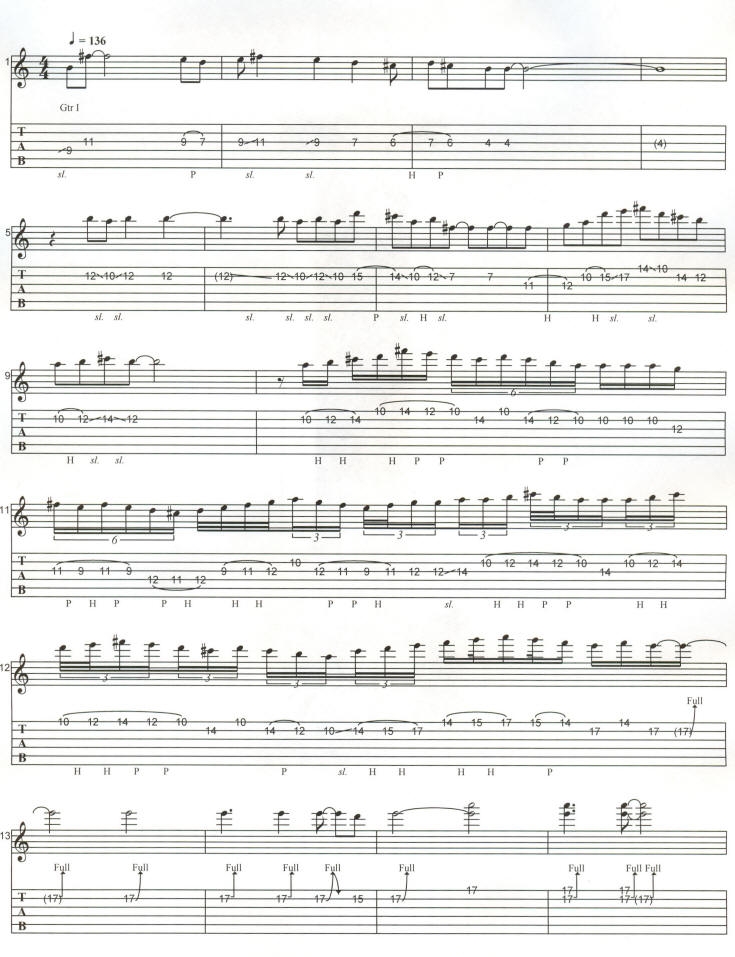
My goal with this solo was to allow it to build dynamically and in emotional content as it progressed. To do so, I wanted to leave a lot of space to start. I didn't want to attack the listener right away with an assault of notes, by doing so it allowed me to develop much faster phrases later in the solo with the hope of keeping the listener engaged. If you look at measures 1-4, you will notice how the rhythm of the notes are made up of nothing faster than an eighth note, actually making good use of half notes and a whole note. This allowed the rhythm section to really come through in the early parts of the solo and allowed the lead to 'breathe'. To keep those sparse phrases interesting, I decided to use slides and hammers to add some color to the notes. To keep with the theme of variety I tried to incorporate ghost slides and reverse ghost slides along with changing notes with a legato slide.
If you notice also the length of the phrases. The solo starts with a simple 2 note phrase that ends with the second note being held for 2 1/2 beats. The second phrase is much longer, incorporating 11 notes, which ends with the final note being held for 6 1/2 beats and followed by a quarter rest. This would illustrate variety in terms of the use of space as I mentioned earlier in the column. This can be seen throughout the solo, sometime long pauses others much shorter.
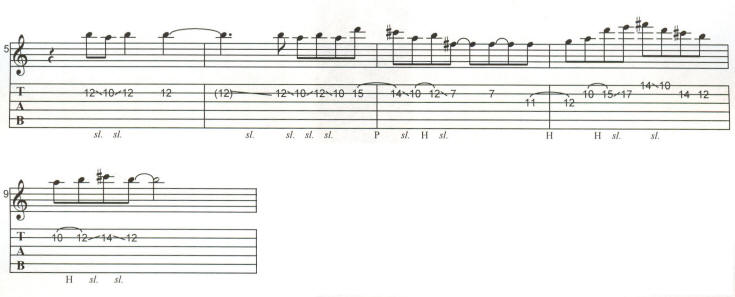
In measures 5-9 above, I continue to make good use of slides and hammers, this time making the phrases and use of slides, in particular, a little busier than the previous 4 measures. Also notice that the amount of space between phrases was shorter than measures 1-4, once again using variety.
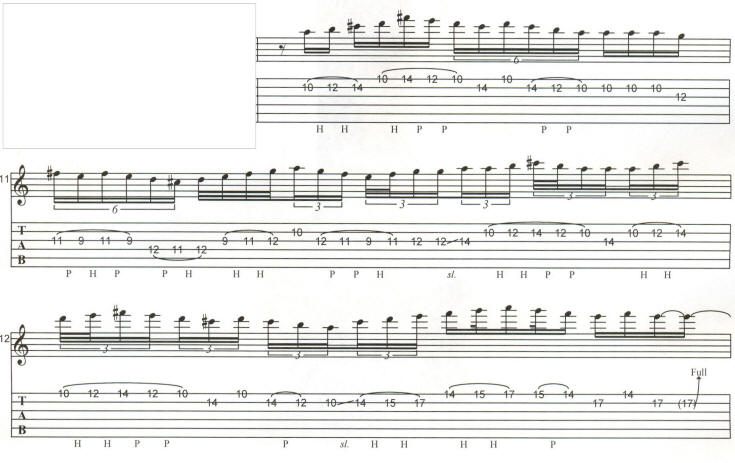
By keeping things sparse for the first 9 bars I have now giving myself the room to open up and let fly with some faster more 'exciting' licks. In measures 10-12, I incorporate some very fast legato phrases using sixteenth note triplets with some thirty-second notes thrown in. Instead of continuing the fast playing for the rest of the solo, I rather used it as a stepping stone to move up the neck to play some higher notes to keep the excitement level high.
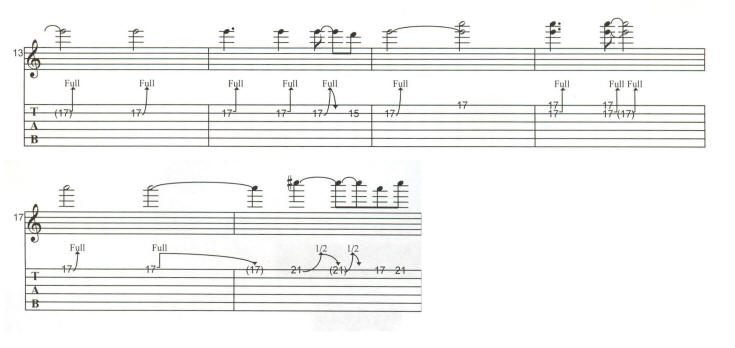
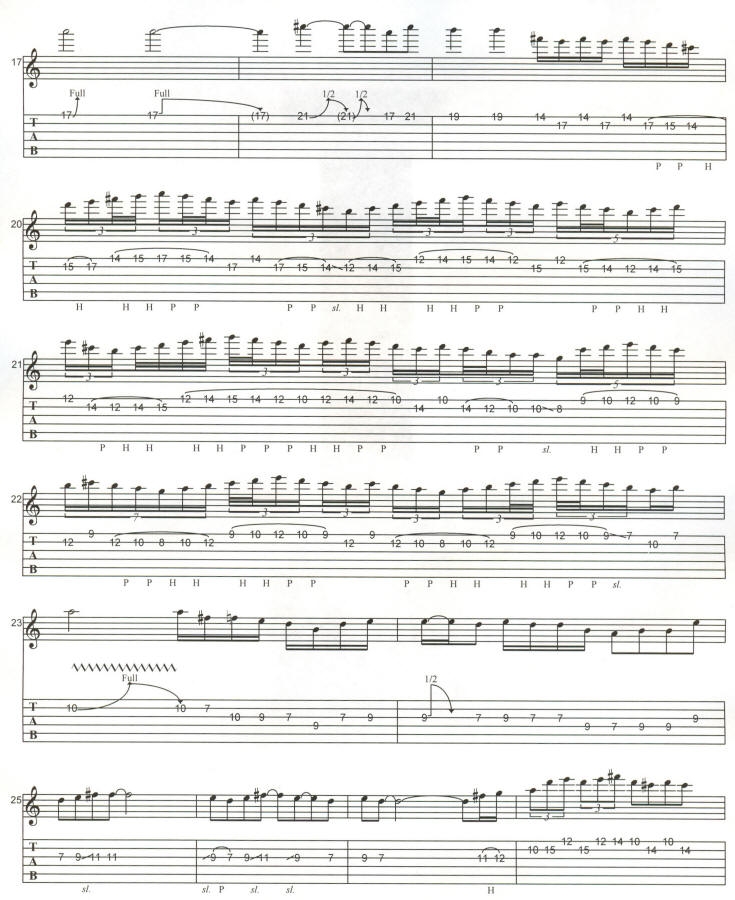
With measure 13, the first bend of the solo is introduced. In keeping with the theme of the use of variety, I wanted to use a technique that had not been used up until now. So far, the solo has made good use of slides along with hammer on and pull offs. It was time to introduce something different. Moving up the neck and using a variety of bends was a very effective tool at this point. Notice the use of both half and whole step bends.
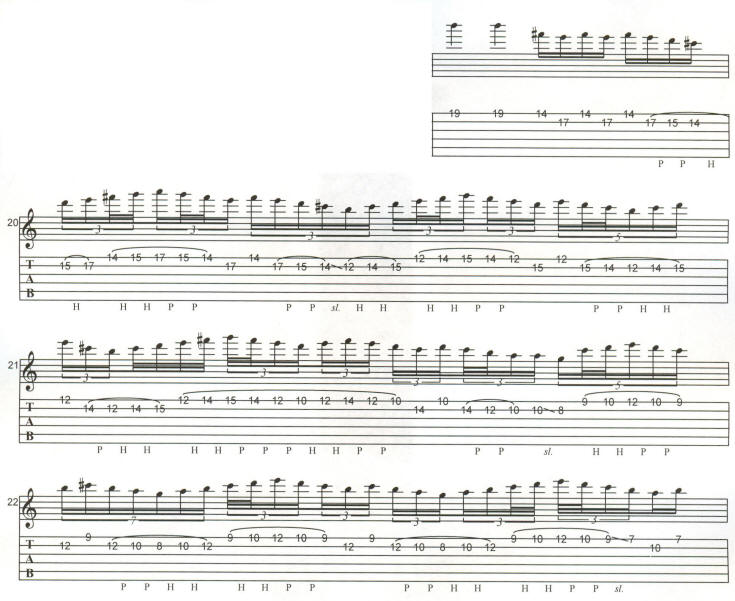
The previous slower, longer phrases once again opened the door for the use of some fast legato phrases. This time varying the rhythms that are part of these phrases. This time along with the use of sixteenth triplets, sixteenth note quintuplet and septuplets are incorporated.
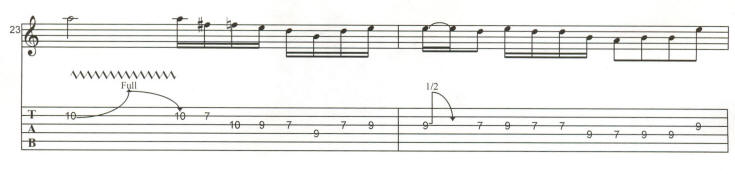
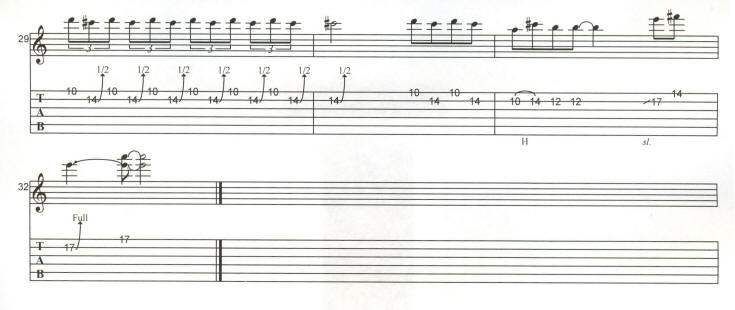
Measure 23 sees the introduction of a slightly different scale. Thus far the solo has been constructed from nothing but the B Natural Minor scale. In measure 23, I threw in a single measure phrase utilizing the B Blues scale to vary things further.

The final 8 measures of the solo allow me the space to apply a combination of a little bit of everything that has been used up until now. I make use of slides, bends and hammers, but to vary things just a little more, I threw in some eighth note triplets, something that had not been used up until now. Another interesting and effective technique is the use of a slightly altered unison bend, using 1/2 step bends instead of the usual full step bends.
So, that is the solo in its entirety. By no means do I mean to suggest that I have exhausted the possibilities of constructing an interesting solo. In fact, each and every situation will call for something very different, possibly the total lack of variety. These are just things that I have found to have worked quite effectively for me over the years to create interesting musical solos that hopefully the listener enjoys. I hope you can take something that I have discussed in this column and apply it in your solos to come up with some great ideas of your own! Thank for looking and happy jammin'! The song "Face Card" is on my CD "Orbit".
Jason Sadites is a guitarist from Canada who has been teaching guitar since the age of 16, and has a consistent roster of between 60-70 students.
His latest CD, "Weve", showcases his strong melodies, tight harmonies and amazing solos over the songs incredible grooves.