The Guitar Player's Resource
Hello, Happy New Year! In this lesson I will be demonstrating a technique I use in my playing called chordal picking. You could just call it picking chords, or chordal arpeggios, but the way I do this technique is in a more chordal fashion, meaning the notes are voiced more toward chord shapes. Some of these can be tricky for your right hand, but they sound really cool. I will be showing you a couple of examples off my instructional video "Creative Speed-Building Picking Techniques" Let's get started.
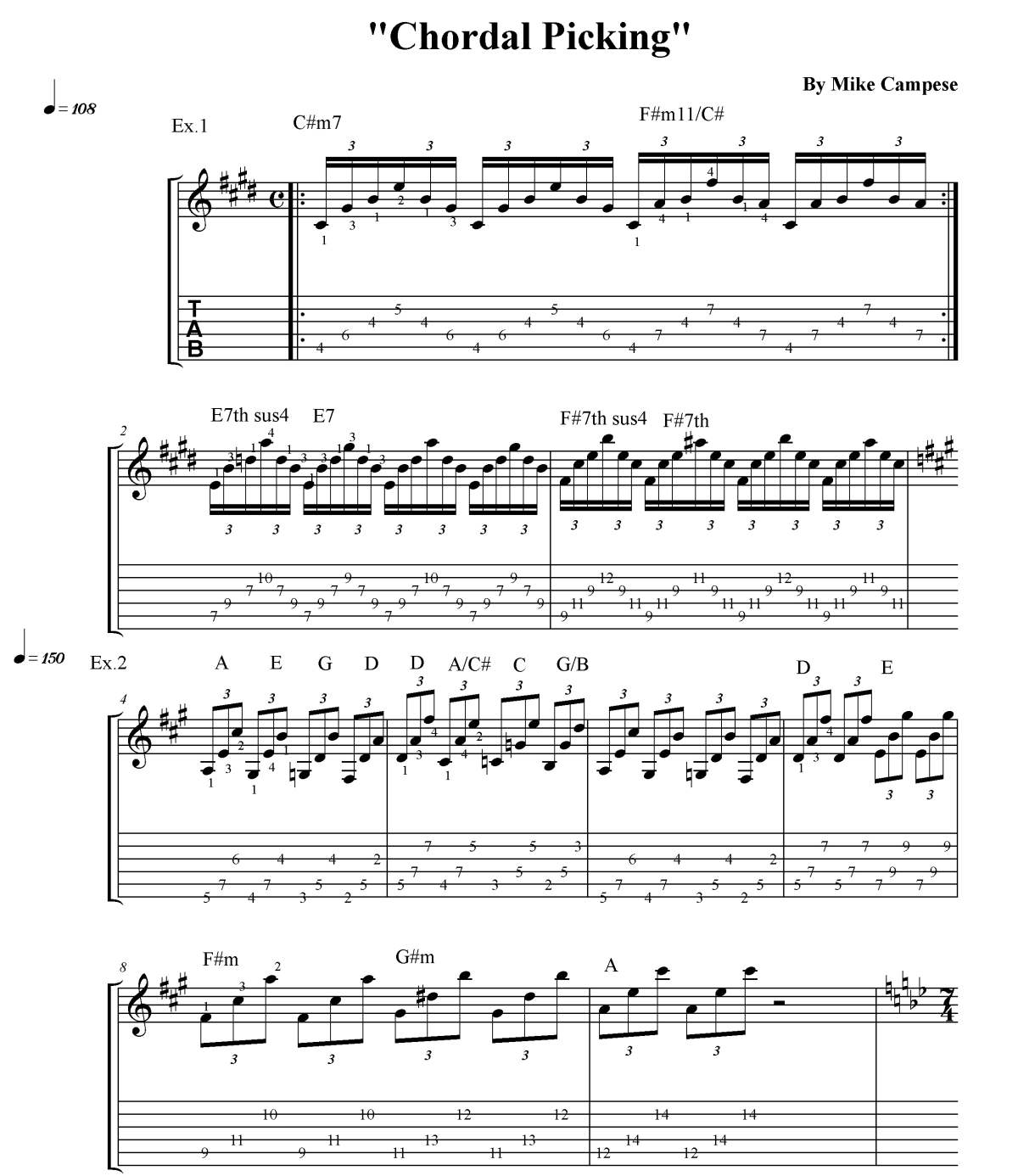
Example 1 Is a series of chords picked in a progression based out of C#m. The first chord C#m7 is voiced (1, 5, b7, b3) which is a common voicing, the second chord in the first bar is a F#m11/ C# - you could also call this chord a C7sus4 with #5. Then it progresses up to E7sus4 to E7 and then up a whole step to F#7sus4 to F#7, these are all common chord shapes. To play this example properly, you must try to not let the notes run together like a chord, they must be picked individually - it can sound messy if they run together, especially if your distortion is on. Be sure to use the proper fingerings listed and alternate pick this whole example, keeping it even as possible.
MP3 - Example 1
Example.2 is based off of major and minor triads and inversions. The triads are voiced so the bass notes of each chord move down in half steps for the first few bars. This is based in A major, but we are changing keys throughout the progression. Most people fingerpick these chords but we will be playing them with just a pick. Use the picking pattern down, down, up, and feel free to experiment with different patterns. You will notice this is tricky to pick because there is a lot of string skipping.
MP3 - Example 2
OK, I just gave you a couple of examples to start you off, once you get the basic idea you can make up your own examples. I use this technique a lot in my playing.
If you have any questions, feel free to email me. Be sure to check out my CDs on this amazing site and check out my new CD release, "The New". Also visit mikecampese.com for more information.
Mike Campese is an all-around music performer, session artist and teacher competent in many musical styles, electric and acoustic. He has studied at G.I.T. (Honors Graduate), and with Paul Gilbert, Norman Brown, Stanley Jordan, Scott Henderson and Keith Wyatt.