
The Guitar Player's Resource
Many of the artists that I grew up listening to, and inevitably influenced by, always had a knack for creating music that really held the listeners attention. They would do this in many ways: great melody, creative arrangements, incredible musical ability, etc. Usually, it was a combination of all these things that really made the music memorable and interesting.
One thing that I always found fascinating was how many artists have used odd time signatures (or numerous time signatures within the same musical piece) as a means of giving the listener something more. Whether it was Rush or Sting (on the guitar side of things, Joe Satriani or Steve Vai) I have always found it a great experience to listen to these artists explore different time signatures. Now, there are many examples of artists who incorporate odd time signatures, but I have always gravitated more towards the ones who use them in a more subtle manner - using them without making it too obvious. They'll do this by slipping in a measure here or there, or possibly adding a section of a tune that incorporates a different time signature, instead of hitting the listener over the head with a blatant odd time (which can be just as cool!) Perhaps, as in Sting's case, using an odd time within the context of an incredibly catchy pop song, almost making it seem as if the song is in 'common' time.
This column is going to focus on how you can use odd time signatures to add some variety to your music and hopefully make it more interesting to all listeners.
In the process of creating music, whether a riff or an entire song, I am sure we have all come to a point where we feel a musical idea or song needs a little something extra. Whenever I reach that point, one of the first places I look to is changing the time signature a little (or a lot) to stir things up. This can be done with a single riff. Often times we write a riff or lead passage on the guitar and repeat it with slight variations.
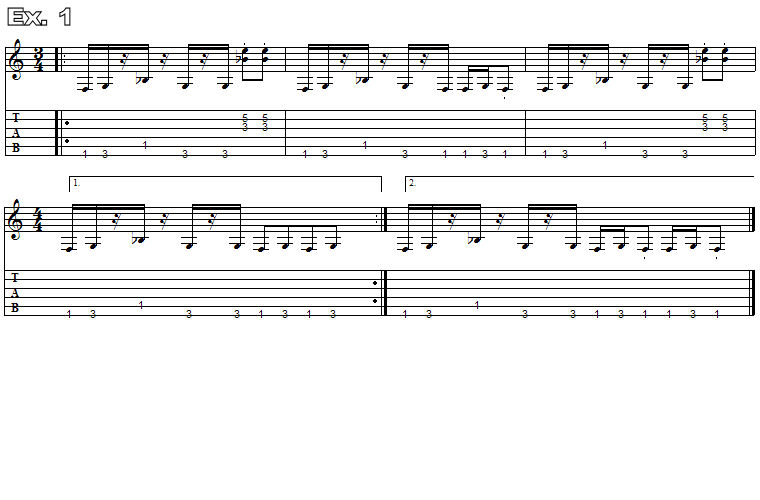
One interesting exercise is to play the riff once and then after a few measures (or when we feel it needs something more) leave out, or add a note or two at the end of the riff, therefore shortening or lengthening it by 'x' number of beats, or parts of beats. When you return to the main riff always treat the start as beat number 1 again. Example 1 illustrates what I mean. It is the title track from my debut release "Orbit". The song stays in 4/4 time throughout until it reaches the bridge. At that point I felt it needed something more, so I decided to write a riff in 3/4 to change it up a bit. What I ended up with is a riff that alternates between 3/4 and 4/4 time, illustrating what was mentioned above.
Example 1
MP3 - Example 1
We see in the example above that every fourth measure ends up returning to 4/4 time for one measure after having three measures in 3/4 time. For the most part the riff does not change that much. The main syncopated feel remains intact, but only the last beat or two have some variation. This way you can get a lot of mileage out of an otherwise simple musical idea without it growing monotonous.
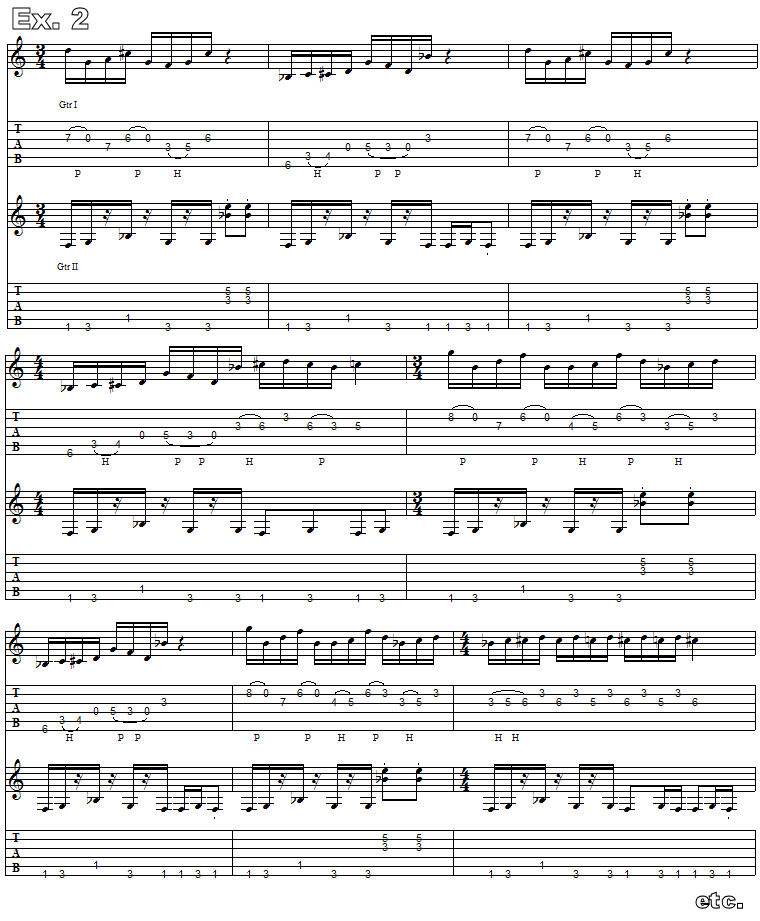
Having composed the above rhythm guitar riff, it then acted as a springboard for lead/melody guitar parts which had to follow the time structure of the rhythm. This is the beauty of creating new parts based off of different time structures; they will then inspire new ideas to go along with what you have just composed. In Example 2 you can see how I took the basic rhythm part from Example 1 and added more variety for the listener by weaving different lead parts over top.
Example 2
MP3 - Example 2
After this the tune returns back to its straight 4/4 time, but by mixing things up in the bridge. the listener was treated to something different that hopefully held their interest - whether they realize what it was that had changed or not.
This is just a quick example to illustrate how changing time signatures throughout a musical idea can help make it more interesting. I hope I have given you something to work with in your own musical compositions. So next time you feel like you are stuck on a musical idea, try incorporating a different time signature even if just for one measure. It might be just what you need to make an already good idea great!
You can here the above examples and others incorporated into my music on my new CD "Orbit", available on this great site! Thanks for looking and happy jammin'!
Jason Sadites is a guitarist from Canada who has been teaching guitar since the age of 16, and has a consistent roster of between 60-70 students.
His latest CD, "Weve", showcases his strong melodies, tight harmonies and amazing solos over the songs incredible grooves.