
The Guitar Player's Resource
There are two ways to understand the modes. The easiest is to relate it to the major scale. Modes are actually the exact same scale as the major scale. They just start on different notes.
For example, if we took the C major scale:
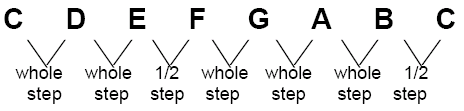
Now, if we started on the second note:
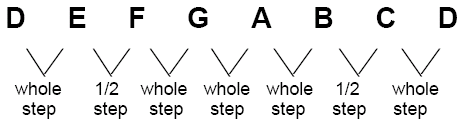
As you can see, although we have the same notes as in the C major scale, by rearranging the order ever so slightly, we have created a new scale formula, and as a result, a new scale sound. This is a Mode of the C major scale.
Now, considering that there are seven notes in any major scale, we can use this method for each of those notes, giving us seven totally different tonalities. If you ever wondered where the odd notes in your favorite melody or solo came from, it is theoretically safe to say that they were from one of these modes.
The other way to learn your modes, although more time consuming, is to memorize the actual formula for each individual scale. For instance, if your major scale steps are 1 2 3 4 5 6 7 , you would memorize which of those steps to flat (lower a fret) or sharp (raise a fret). As you can see, this can be a tedious process.
However, the results to this method are most lucrative, as you then need only learn major scale fingerings. Then, if you wish to change modes or tonalities, you merely use the same fingering patterns and change the required notes for the mode which you wish to use.
Confused? Probably. This is why I've given you complete examples of both methods so that you may gain understanding while learning.
This is the first step in the understanding of the origin and use of the seven major scale modes. They are going to be explained and charted for you to try. As with anything, memorize one at a time, so that you do not confuse similar sounding modes, and can identify each one independently.
All of the examples are based on the C major scale.
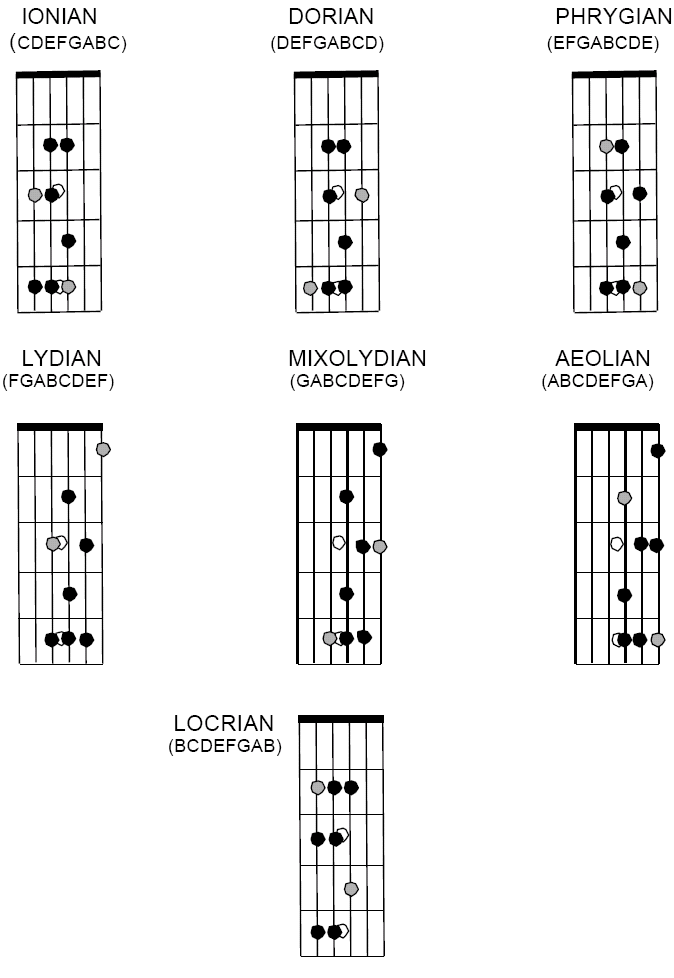
As you work on these examples, you will notice that the Ionian Mode is actually a fancy name for the major scale. Likewise, the Aeolian Mode is just the minor scale. When playing modally, it is important to know these new names for the scales.
After you are confident in these fingering positions and definitions of the Modes, we can move on to the scale step formulas involved in these modes. After all, The major scale is not always "C", so Dorian is not always in "D"! This is just the beginning to modal composition. That's why it's important to know and understand their formulas!
Let's recap, shall we?
That's it - keep on playing. Sorry it's been so long since my last post. I was on the phone...
Paul Kuntz is a working studio musician and has been a professional instructor for past ten years. Paul graduated from the Musician's Institute in 1990, and is author of the guitar instructional book "Chords Scales, Theory and Shellfish"..
He also is a studio engineer and producer for unsigned artists.