The Guitar Player's Resource
In this essay, I am going to apply a number of The Principles of Correct Practice For Guitar to a technical area that is of major concern to players. For beginners, it poses one of the most challenging difficulties, and an incomplete appreciation of its difficulties dogs many an advanced player (sometimes without them being aware of it).
Bar chords are what I am referring to, those nasty, difficult guitar chords that we run into sooner or later as we try to play our favorite songs. I am going to address the physical, technical aspects of learning these chords in a way that will enable you to avoid the difficulties that attend the learning of them for most players.
I remember when I first learned them. It was the "tough" school, the school of hard knocks. The school of "here is where to put your fingers, I know it feels impossible, you're not getting most of the notes out, but if you stay with it long enough, you'll be able to do it." And that is true; I did "get" them. After months of lessons where I was forced to keep up a rhythm while my teacher played the lead over a lot of great jazz tunes and standards I am happy to have learned, the pain in my thumb and hand and arm began to subside. I was getting stronger and that was good.
What I didn't know was that even though I was learning to keep up with these chord changes, I had so much muscle tension in my arms and other parts of my body, that I was locking in tensions that didn't have to be there, and would come back to haunt me a few years later as I attempted the classical repertoire, where you don't really get away with things like that.
As the years went by, and especially in teaching others, I realized that it doesn't have to be that way for anybody! There is a way of going about it that doesn't create or allow this situation. In fact, it makes learning things like bar chords an orderly, if still somewhat demanding process. And the result is a very comfortable feeling while doing them, and the proper basis for more advanced techniques, such as keeping a bar down while the other fingers do all sorts of things that demand great control.
Now before I go into some actual exercises, make sure you have read my other essays, especially "Discover Your Discomfort", "The Secret of Speed", and "How To Practice Chord Changes". There you will find explanations of some vital concepts, such as The Floating Arm, and the Light Finger. These are names that represent the internal physical and mental feelings that good players have when doing things like bar chords. You will also find specific exercises so that you can discover these sensations for yourself. If you have already read them, read them again! And do the exercises.
After gaining an appreciation of the Floating Arm and Light Finger, you need to discover the Heavy Arm and Firm Finger. These are the names that describe the sensations that accompany the actual doing of Bar Chords, and they proceed from the Sensations of the Floating Arm and Light Finger, that is, the Floating Arm and Light Finger must come first.
Do this to discover the sensation of the Heavy Arm and Firm Finger:
This is the heavy arm, the arm that is totally relaxed and not held up by its own power. It is the opposite of the Floating Arm. Good players are aware of these sensations, and constantly shifting between them as the left hand functions on the neck.
Now do this to discover the Firm Finger, which is used to direct the weight of the arm to the strings.
This is how the Firm Finger functions with the Heavy Arm in playing. We will use these sensations in learning Bar Chords.
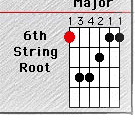
Here is the most basic bar chord to know, one everyone needs to be able to play eventually. It is the lucky guitarist who learns the correct approach to this chord, one that will lead to easy mastery.
I am going to walk you through an approach to dealing with this chord that will be a very good way to first learn it, or re-orient your current approach.
Let's do this chord at the fifth fret, an easier place then the first fret. Do this:
Holding the guitar in a relaxed way, keep the right hand comfortably placed near the strings, very relaxed. Keep the left hand and arm down at your side.
Slowly raise the arm and hand without raising the shoulder in the least. Touch your light, relaxed middle finger to the 3rd string, 6th fret. Make sure you bend the finger at all the joints, especially the tip joint. Be aware of and relax your entire body as you do so, especially shoulders and arms.
Now touch the light relaxed 3rd finger to the 5th string, 7th fret. Place it right behind the fret. You will have to stretch it away from the 2nd finger to do so. If you are paying enough attention, you will notice a small degree (or maybe more) of tension coming in to your hands and arms as you make this small stretch. Relax that tension out (always do this during stretching motions).
Keeping the Floating Arm with Light Fingers touching the strings, bend your pinky and tuck it in behind the 3rd finger, touching the 4th string, right behind the 7th fret. Make sure the pinky bends at each joint, especially the tip joint (distal joint). Not doing this is a common fault, especially when first learning these chords. It is bad because without the right bend in the joint, your force is not focused correctly on to the string, and you will then be creating tension in your arm.
You now have fingers 2, 3, and 4 down, all light, not even pushing the strings to the frets. Look at the space between the strings and the fingerboard to make sure this is so. Double check your relaxation.
Now allow the fingers to become Firm, as you allow the arm to become heavy. The weight of your arm will be coming through your Firm Fingers, to accomplish the job of getting the string to the fret. Because of this, very little effort is actually required from the thumb. Only a little squeezing action directed toward the pressure coming from the fingers. When you do it just right, it is a very relaxed and balanced feeling.
Now the big moment. Placing the 1st finger across in the Bar. There is one very important thing to take notice of here. Unlike the approach most people use in learning Bars, we are placing the Bar down last, not first. Placing it down first will tie your other fingers up with tension that you will then be fighting with.
If done correctly, you will now be able to lay the Light 1st finger down on to the strings. Flap it up and down a few times to insure its lightness and relaxation.
Check over your hand and the rest of your body for relaxation again, and then allow your first finger to become firm, and to bring the weight of your arm to the strings. Do this very slowly, adding a little squeeze with the thumb from behind.
I have used this approach with beginners, and have often had them doing a perfect Bar Chord the first time out, if it is done exactly right. True, it is a lot easier if someone is there to give correction on all the nuances of finger placement, but I hope I have been detailed enough, and that you will try this out with great attention, intelligence and persistence, and that between the two of us, something useful will occur.
Jamie Andreas is a virtuoso classical guitarist from New York.
She started playing guitar at age 14, by 17 she was giving concerts and teaching guitar.