The Guitar Player's Resource
This article is an example of how to move music composition outside the normal - I IV V - zone. The concept is to use a basic pivot chord idea as a device to move into different keys. As an example, moving from an A major key to its parallel minor key (A minor). However it can get more interesting than that. I want to expand this further by showcasing an entire composition of only 16 bars and how I structured it.
For those of you who have not studied music in a classical way I need to explain the numberings under the chords. These numbers refer to the distance between the intervals when the chord is inverted.
7th Chords
|
6 5 |
4 3 |
4 2 |
| 1st Inversion | 2nd Inversion | 3rd Inversion |
Triads
|
6 |
6 4 |
| 1st Inversion | 2nd Inversion |
This is a quick example of how you can cut up 16 bars of music and take the sections into different worlds of harmony. I have ignored using multiple key signatures because I didn't want to make the score messy and confusing. I have divided the chords into 4 groups of notes (stems up and down). In other words (vocal style) because aside the inversions there is voice leading occurring here. I will talk more about voice leading in future.
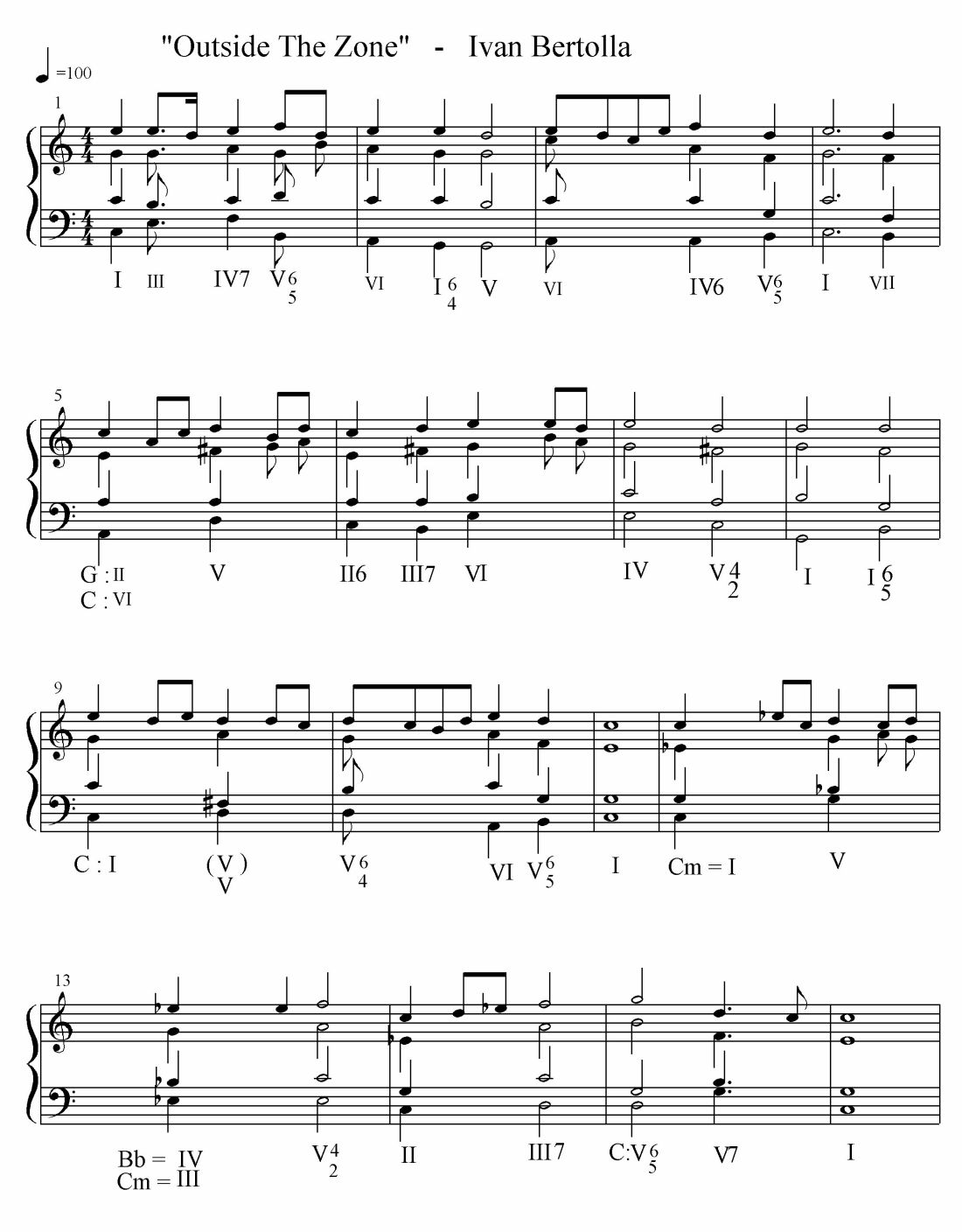
The first thing to notice is bar 5. I have pivoted into the key of G major but not in a cliched way (parallel major/minor). The A minor chord = VI in the key of C Major and = II in the key of G Major. So it was ideal in this melody to use as a "pivot chord" and smooth transition from the key of C to G. The most cliched way of moving into another key happens at Bar 12. I use the parallel minor pivot from C major to C minor. In bar 13 I briefly went to E flat. The E Flat major chord = IV in the key of Bb Major and = III in the key of C Minor. I used the obvious dominant 7th in C to get back to the start of my piece which started in C major. Try and play this on a piano and you will hear how the piece gets "out of the zone". This technique will only improve how you write music. If you know your music theory you can pen ten of these out without hearing the melody and know that it will work every time. I advise you to learn the four diatonic harmonies in major and minor for both 7th chords and triads.
Ivan Bertolla is a Melbourne Based composer, producer and guitar instructor who has released his debut CD worldwide of Cinematic music "Beyond The Skies Eternity".
He runs Mastermind Productions and Macleod Guitar School.