The Guitar Player's Resource
Hello fellow guitarists! Last time we analyzed reasons why scales sound exotic. This time, I'll show you two of the most popular Japanese scales!
Maybe that you already play some Japanese scales. Maybe that you know the names of some of the scales. Often, the scales are called "Hira" or "Kumoi". But, these are names of tunings, not of scales! OK, let's dig deeper...
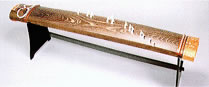
"Koto" is the name of a Japanese traditional music instrument. It's a kind of zither. It has been used as one of the main chamber instruments of Japanese traditional music style. The length of koto is about 180cm (shorter model: 90 cm) . A traditional koto has 13 strings, being arched tautly across 13 movable bridges along the length of the instrument. Players make different string tunings (base pitches) by moving these 13 bridges. Two of the most popular tunings are named Hira and Kumoi:
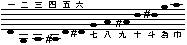
Kumoi (Kumoi Zyoushi)
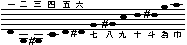
1 b2 4 5 b6 ...MP3 - Kumoi Tuning
Each string has its own name, starting from the lower side: ICHI(1), NI(2), SAN(3), SHI(4), GO(5), ROKU(6), SHICHI(7), HACHI(8), KU(9), ZYU(10), TO(11), I(12), KIN(13). Five strings are equal to one octave. That's why these scales are named "Pentatonics" ("Penta" means five in Greek. Pentatonics consist of five notes!)
The #s are somewhat lower than in the Western music system.
--> Conclusion #1: HIRA and KUMOI aren't scales, but TUNINGS.
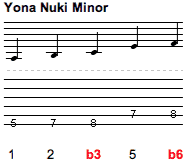
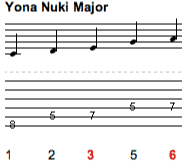
One of the most popular scales is the Yona Nuki scale. "Yona Nuki" means "omit the 4th & 7th note of the scale". Basically, there are two versions:
Note: The Yona Nuki Minor Scale has the same intervallic structure as the Hira Tuning.
MP3 - Picking and tapping break using the Yona Nuki Minor scale
MP3 - Whammy theme using Yona Nuki Major
Another very interesting scale is the In scale.
To reinforce the effect of this scale, play a b7 for an ascending melody, and a b6 for a descending melody.
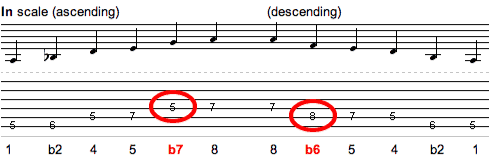
MP3 - In
MP3 - Break using the In scale
Yes, you can use a similar concept of modes as with other scales (Ionian, Dorian,...).
As an example, try the 5th mode of the ascending In scale! How to do that?
It's simple: As an example, play an E in the bass and then improvise with the A-In scale (the In-scale starting on an A). Now you're playing in the 5th mode of the In scale.
MP3 - A smooth melody blending the 5th mode of the In scale (middle part) with the chromatic scale
--> Conclusion #2: YONA NUKI MINOR and IN are popular SCALES.
I often use these Japanese scales, either in a pure form, or blended with other scales. If you want to learn these Japanese scales, do it, and name them correctly - Yona Nuki and In.
Note: All sound samples are taken from my exotic metal album "Electric Storm".
If you have any questions, don't hesitate to contact me.
Dan Keller, Switzerland's Sultan of String, is a guitarist whose original compositions showcase his exotic metal fretwork.
His debut CD is entitled "Electric Storm".