The Guitar Player's Resource
If I asked you would you rather spend 10 years learning an instrument, or a year with the same results, what would your answer be? Most people would say the year. Others may think it`s not possible. Can you actually learn an instrument's structure as well as someone who has been playing for many years - in a shorter time?
One thing must be understood: in order to get this kind of result you have to have a different approach. When you really know something you can visualize it, or see it in your mind. The whole approach to learning things is all about getting to a place where you can visualize what you do. Some people achieve this by doing something over and over again to memorize it. Others use the power of visualization.
When you can visualize all the chords and scales you could play on an instrument you are not really relying on what you remember. The difference is you can lay off an instrument, or not practice for long period of time, and the minute you pick that instrument up again you can see the instrument structure.
Let`s look at a chord for an example. I can practice a chord shape so my hand remembers where to go. Or I can practice that chord shape using a visual pattern that I use to remember that chord. Let's use a chord shape that has 5 strings for our example.
Now, looking at the two ways of learning we have these options: practice a chord over and over trying to remember where each finger goes for each one of the five strings, or use a visual tool that is used to create that chord that only has two notes. What would you rather use? The chances of you remembering the chord using two notes is greater than trying to remember all six strings.
Below are the notes of the G7 chord. They are the B and F. These two notes form what is known as the tritone. Any 7th chord will have any one of these two string shapes. So if you can look for these in any dominant chord you will have two notes of the chord visualized.
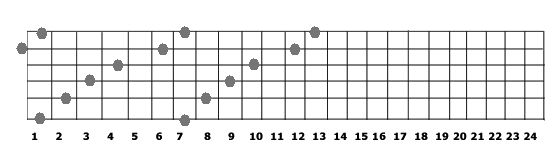
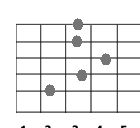
Below you'll see a G7 chord with B in the bass. Look and see if you can the tritone in this chord. Now, use this example as possiblities to use visualization. If you look hard enough at chords and scales, you will find visual tools to use.
When you look at visual patterns as opposed to memorization you will always be able to play the things you learn. Thus, the mind can, as an option, be trained to learn an instrument with visual patterns and not memorization alone. Memorization is a long tedious process that does not produce the same results as visualization. The two paths of learning may be separate, however the end result is the same. The objective is to be able to see the chord or scale in your mind.
In summary, you can learn an instrument much faster with less frustration. Many people are starting to experiment in all fields with visual approaches to learning. Why should instruments be any different? In fact, many great guitar players use visual shapes to help them learn. You can even crerate your own unique visual tools. I encourage you to check out methods of visualization as well as take a deeper look at how you are learning. Before you set out to learn a new chord or scale look for visual patterns that will help you as you practice. Once you start to look for visual patterns you will find them! Playing an instrument using visualizastion is a reality and offers a lot of freedom.
Greg Brown is a guitarist and instructor from Texas who has written instructional books and authored videos and CD-ROMs designed to help a wide variety of guitar students..
His latest work is a method called the "Master All Strings Visual Learning System" that leads a guitar player into total visualization of all chords and scales as opposed to memorizing everything.