The Guitar Player's Resource
Hello everyone and happy holidays! It's great to be back! In this lesson we are going to talk about modal interchange (Satch might call this pitch axis - they are both related). You will learn what these powerful compositional tools are, and I will also give you some examples. I use these techniques in my writing. Joe Satriani uses a lot of pitch axis in his music too. Speaking of Satch, I recently had the opportunity to talk to him, he was really cool. OK, let's get started.
Modal Interchange is major and minor keys that share the same tonic, and it's also known as Parallel Major and Minor. For example, let's compare the chords in the C major scale and the C minor scale:
C Major: C Dm Em F G Am Bdim
C Minor: Cm Ddim Eb Fm Gm Ab Bb
You can mix major and minor keys in the same progression. For example the progression C Eb / Dm / Ab Bb / C. The main key is C major, i just borrowed the chords Eb, Ab and Bb from the C minor scale.This works in any key, Emaj-Emin, Amaj-Amin, etc. This will give you more chords to choose from, so feel free to experiment with other progressions.
Pitch axis is basically the same concept as modal interchange. For example, over an E pedal tone, or bass note, you can mix E Lydian (E, F#, G#, A#, B, C#, D#) E Ionian, (E, F#, G#, A, B, C#, D#) E Mixolydian (E, F#, G#, A, B, C#, D).You will hear Satch do a similar thing in his music. What i will do a lot of times is play a E drone note and mix all the 7 modes together. This is a great way to hear the different moods of each scale. Certain modes do sound better than others. It is like mixing different colors together. Also, the fewer notes you use in the bass, the more harmonic freedom you will have.
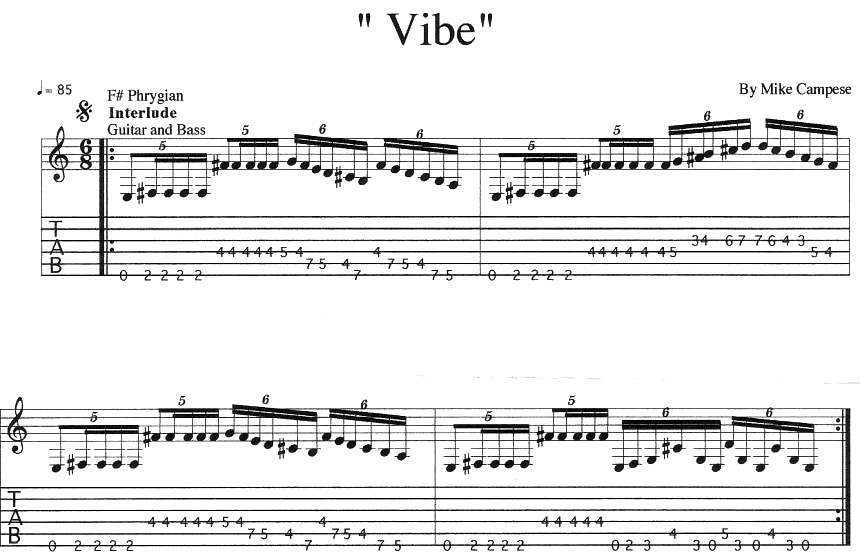
I use this in my music; here are a few examples. On my "Full Circle" CD, there is a song called "Tinted Windows" where I mix the C Mixolydian mode (C, D, E, F, G, A, Bb) and the C minor scale (C, D, Eb, F, G, Ab, Bb). The progression for the verse is C7 / Ab Bb / C7. The second verse will stay in the C Dorian scale (C, D, Eb, F, G, A, Bb) and go back to C Mixolydian, etc. On my "Total Freedom" CD, the song "Space" there is a E drone and I switch between E Aeolian, E Lydian, E Ionian, similar to what we talked about above. Also on my latest CD "Vibe" (the titled track) in the intro I mix the F# Phrygian (F#, G, A, B, C#, D, E) and the F# Phrygian Dominant scale (F#, G, A#, B, C#, D, E). These are just a few short examples - experiment with this in your music. I will leave you with a transcription of the intro to "Vibe".
 <
<
MP3 - "Vibe"
OK, this wraps up our lesson! Make sure you spend some time with these techniques. If you have any questions, feel free to email me. Be sure to check out my CDs on this amazing site and check out my new CD release, "Vibe". Visit mikecampese.com for more information.
Mike Campese is an all-around music performer, session artist and teacher competent in many musical styles, electric and acoustic. He has studied at G.I.T. (Honors Graduate), and with Paul Gilbert, Norman Brown, Stanley Jordan, Scott Henderson and Keith Wyatt.