The Guitar Player's Resource
Hello everyone! It's great to be back! I've been getting a lot of great feedback from you and I really appreciate it. I really love doing these lessons! Also, I'm very excited about my new CD "Vibe". OK, this lesson I will be showing you some Modal Progressions. It' very important to know how to put the modes to use and create progressions. I played a solo over the progressions so you could hear what it would sound like. So let's get started.
Example 1 is a jazzy progression in A Dorian. In the first bar we are using the minor chord Am with added extensions like the 6th, 9th and 11th, which are all diatonic to A Dorian. If you are not sure what the diatonic chords are in A Dorian, they are Am7, Bm7, Cmaj7, D7, Em7, F#m7b5, Gmaj7. The last 2 chords in the second bar are the b7, G and the four chord, D9. To bring out the Dorian flavor, I put the A in the bass over all the chords.
MP3 - Example 1
Example 2. Here we have a progression in E Phrygian. This progression is built mainly with triads from the E Phrygian scale. The Diatonic triads in E Phrygian are Em, F, G, Am, Bdim, Cmaj, Dm. The E ringing over the triads really brings out the Phrygian flavor. The F/E chord in the first bar creates that dark Phrygian sound. Experiment using each one of these triads over an E pedal tone. You can come up with some cool sounds.
MP3 - Example 2
Example 3. Now we are using two different modes: D Ionian for the first 2 bars and D Mixolydian for the last 2 bars. There is only one note different between both scales - the Ionian has a Maj7th and the Mixolydian has a b7th. The diatonic chords in D Ionian are Dmaj7, Em7, F#m7, Gmaj7, A7, Bm7, C#m7b5, and the diatonic chords in D Mixolydian are D7, Em7, F#m7b5, Gmaj7, Am7, Bm7, Cmaj7). Since these two scales are similar, it makes it easier to make up progressions that flow between both keys. Don't forget to tune your low E to D.
MP3 - Example 3
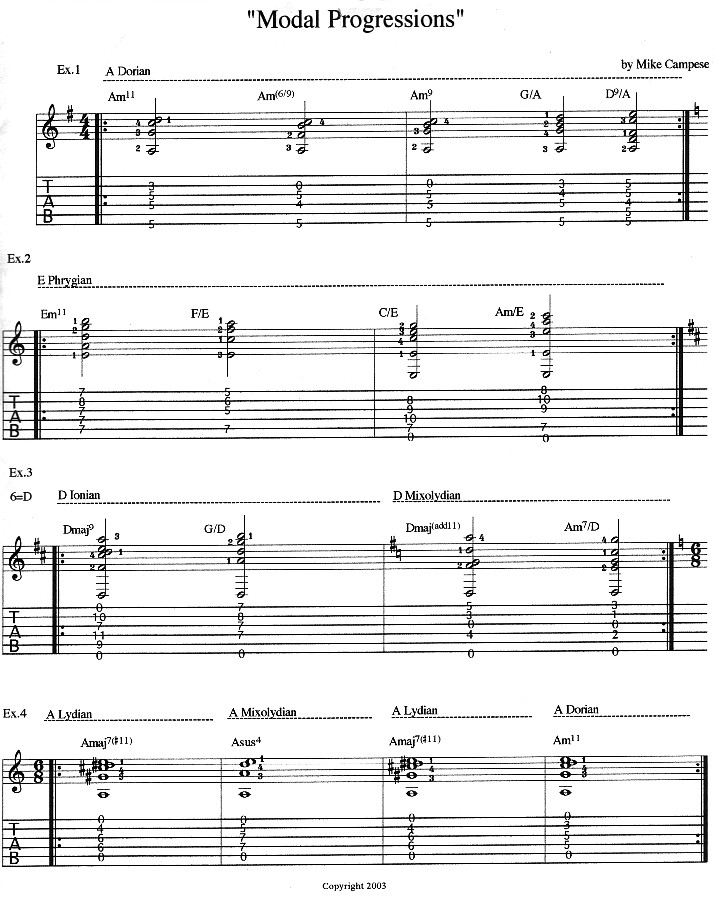
Example 4. For our last progression we are mixing three different modes together: Lydian, Mixolydian and Dorian, all over an A tonality, in 6/8 time. This is something Joe Satriani might do. We are playing the exact chord shape and moving it in half steps. By moving this chord, we are matching each mode.This is a very cool thing to do, because you can establish many different moods in your music. Experiment, staying in one area of the neck when you are playing over this progression.
MP3 - Example 4
OK, this wraps up our lesson! Make sure you record these progressions and play over them and most importantly, make up your own. If you have any questions, feel free to email me. I use the modes in most of my music, so be sure to check out my CDs on this amazing site and check out my new CD release, "Vibe". Visit mikecampese.com for more information.
Mike Campese is an all-around music performer, session artist and teacher competent in many musical styles, electric and acoustic. He has studied at G.I.T. (Honors Graduate), and with Paul Gilbert, Norman Brown, Stanley Jordan, Scott Henderson and Keith Wyatt.