
The Guitar Player's Resource
Welcome back everyone! Happy summer! I hope everything is well and your summer is going great. I want to say it is a honor to be a part of one of the best guitar sites on the net. I hope you take the time to explore this site and check out the goods. Okay, let's get started...
In this lesson we are going to talk about learning major scales all over the neck, in different ways. It is very important to learn the major scale over the entire fretboard in all keys. This is very helpfull in so many ways. It is a major key to playing solos, improvisation, modes,etc. If you're not familiar with the major scale, let me explain what it is.The major scale is built with whole steps and half steps. For example, the scale formula is: whole, whole, half, whole, whole, whole, half. If you notice, the half steps occur between the notes 3 and 4, as well as 7 and 8. This is the same in all keys.The notes in the C major scale would be (C, D, E, F, G, A, B). In the key of G the scale would be (G, A, B, C, D, E, F#). There are only 7 notes in the scale; the eighth note is the same as the first. The first note you start with is the root. Play any note on your guitar and follow the scale formula and you will have a major scale.
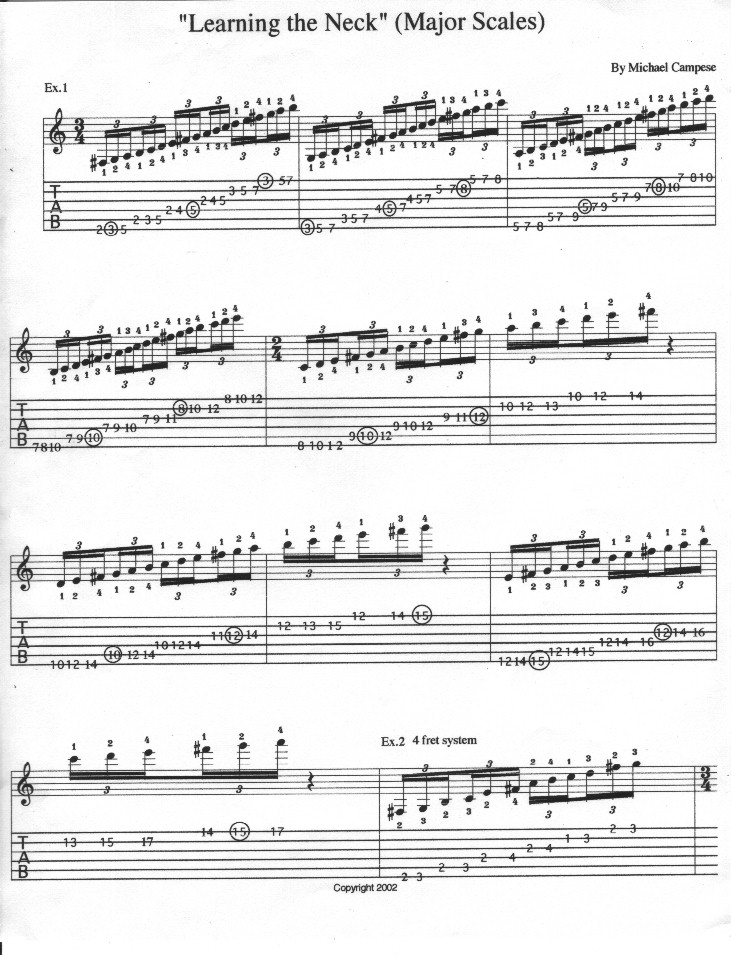
Example 1 - Here are seven basic, three-note-per-string, major scale shapes in G Major (G, A, B, C, D, E, F#). The circles are the root of the scale. Memorize each of these shapes inside and out. This is the key to soloing. It is also very important to say the notes to yourself when you are practicing these scales. Eventully you can modify these shapes in different ways. Once you memorize these shapes, move them up or down the neck in different keys. If you are familiar with the modes, you will notice these are the same scale shapes.
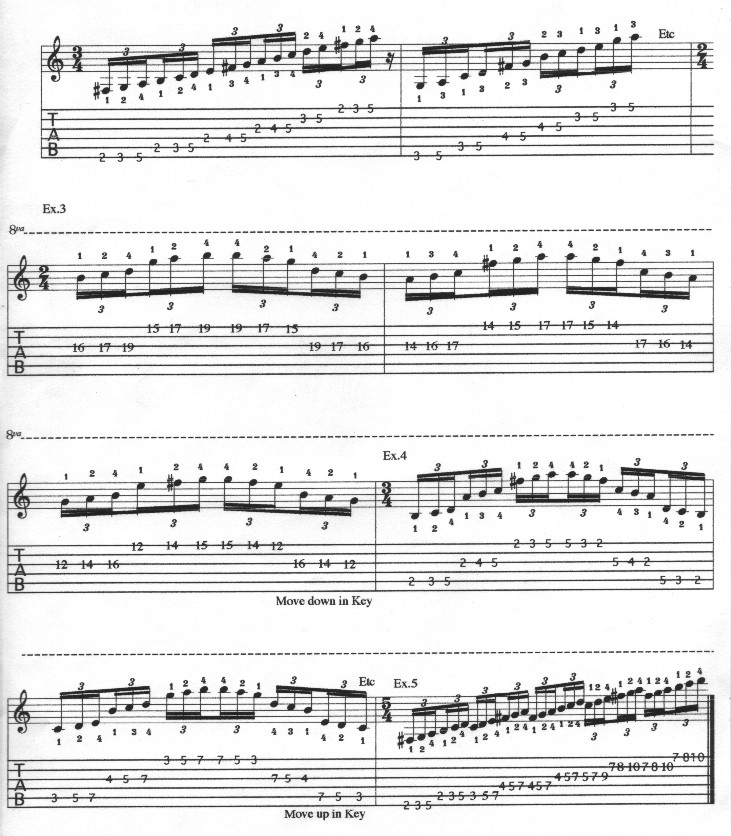
Example 2 - Once you memorize the shapes in Example 1, the next great way to learn the neck is to use the "4 fret system". For example, playing only the notes in the scale using the first 4 frets of the guitar. Then between the frets 2-5, 3-6, 4-7, etc. You can get some interesting shapes and sounds practicing this way .I think this is the best way to learn the scales.
Example 3 - Now you should be more familiar with these scales. In this example, we are going to start connecting the shapes together. This is a string skipping idea that moves down the neck in G major. Continue this down to the first fret and back up. Do this on other strings as well.
MP3 - Example 3
Example 4 - In this example, we are skipping down to the 5th string. A little crazy, but great for your picking and great for visualizing the neck. Move this all the way up the guitar. It is important to use these ideas in musical situations.
MP3 - Example 4
Example 5 - Our last example moves across the neck with a 6 note,16th note triplet run. This one is great for getting around the guitar. Do this in different positions up and back. Make sure you are alternate picking these lines also.
MP3 - Example 5
This wraps up our lesson. These are just a few ways to learn the neck. There are millions of possible patterns you can make up using these concepts. Make sure you learn these in all 12 keys, ans in the open position of the guitar as well. Learning the neck is the key to being a great improviser. Check out my CDs "Full Circle" and "Total Freedom", and for more information visit www.mikecampese.com. Good luck!
Mike Campese is an all-around music performer, session artist and teacher competent in many musical styles, electric and acoustic. He has studied at G.I.T. (Honors Graduate), and with Paul Gilbert, Norman Brown, Stanley Jordan, Scott Henderson and Keith Wyatt.