The Guitar Player's Resource
The previous installment dealt with the control versus speed issue. In this article I want to dive a bit deeper into developing some serious synergy between the picking and fretting hand. This can be achieved by combining multiple picking techniques into one exercise. You can come up with many interesting sounding licks when you integrate this technique into your improvising. Feel free to reshape these exercises to fit your style, be musical about it, that way you won't come off sounding too clinical. Today I'm going to talk about the two most common picking techniques, sweeping and alternate picking, and some different ways to combine them.
These exercises will be beneficial in two additional ways as well. First, I think they'll help with fret board visualization. Arpeggios are great landmarks that can help you identify where you are on the fret board in relation to the mode you are playing in. Since these exercises are a combination of arpeggios and modal fragments it should help you navigate the fret board a bit easier. Another benefit with these exercises is that they involve some inside picking. As you reach the top of the arpeggio and begin the return trip via the mode, you will be starting on an upstroke instead of the usual down stroke.
The three diagrams below illustrate the more common combinations to start out with.
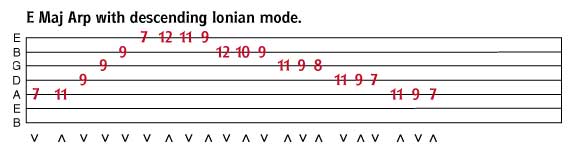
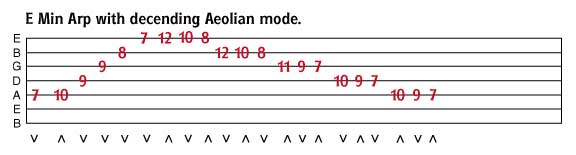
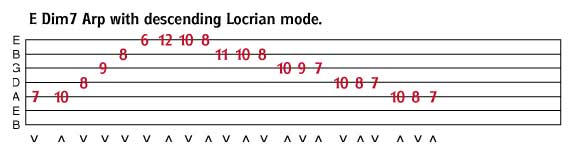
You can pretty much customize these combinations to get the sound you are looking for. Using a Dom7 arpeggio and descending in the mixolydian mode is another straight-ahead combination. If you want to do something a bit more ambiguous you can use the Sus4 arpeggio and come down in any diatonic mode you want. Also don't forget about the Min Add2 or any other scale tone arpeggios, just make sure that if you wish to remain diatonic be careful of the scale tones as they can begin to limit you modally.
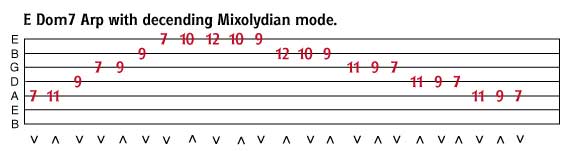
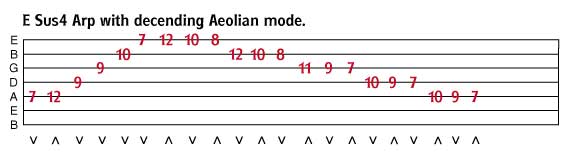
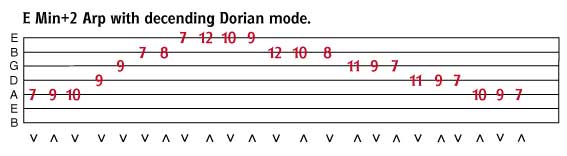
Finally for some more challenging technique, have a look at these three octave arpeggios. These can be a bit brutal at first, especially the Dim7 but they are a great way to quickly get up the neck and they sound pretty cool too.
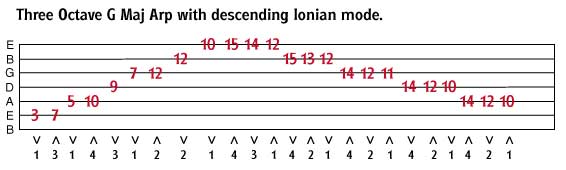
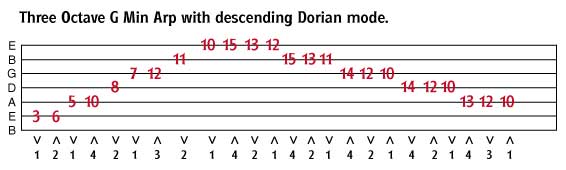
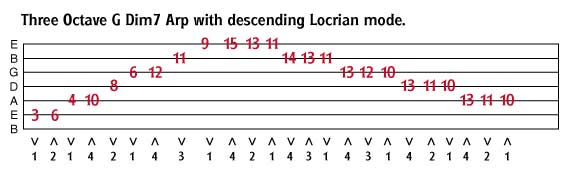
I hope these exercises prove beneficial in your playing. I know they helped me quite a bit, and still do! If you are interested in hearing some of these concepts applied in a musical context, feel free to check out my CD "Wyrd". Thanks for stopping by!
Greg Rapaport is a seven-string guitarist/bassist whose musical focus is a blend of instrumental progressive-metal and jazz-fusion. Greg has been on three tribute CDs (Led Zeppelin, Jeff Beck, Jimi Hendrix - BHP Productions) and has released three critically acclaimed CDs. Greg is currently teaching in upper Westchester County NY.
His latest instrumental CD is entitled "Homunculus".